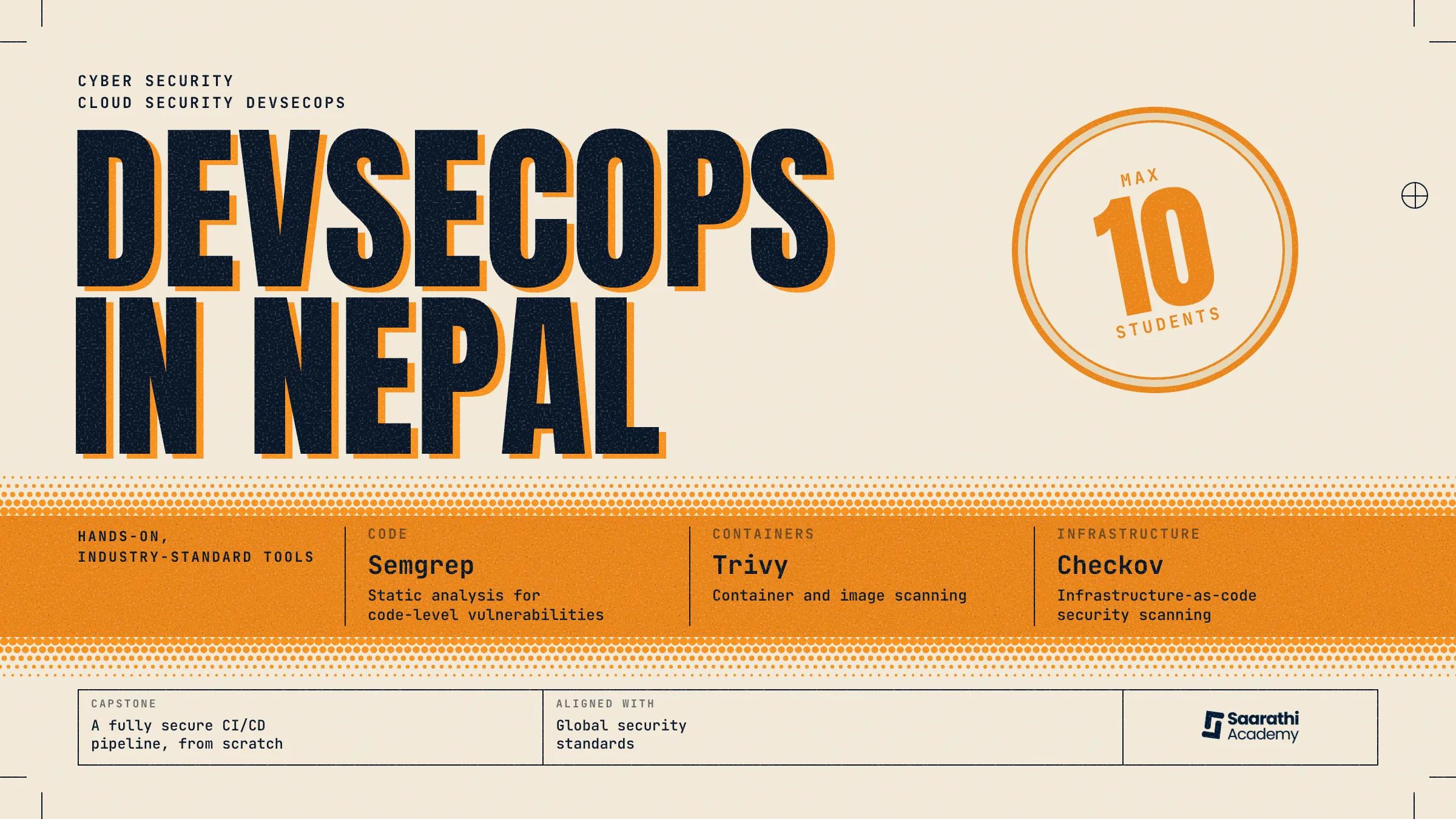
Cloud Security DevSecOps Training
Cloud is no longer the future; it’s the default for modern businesses. From startups in Kathmandu to global enterprises, organisations are rapidly moving to AWS, Azure, and cloud-native systems. But most are prioritising speed over security, and fixing it later is often too late.
That’s why Cloud Security DevSecOps Training in Nepal is becoming essential. Security must be built into every stage of development, not added at the end. DevSecOps ensures security is integrated into code, pipelines, and deployments from day one.
In Nepal, there’s still a gap between theory and real-world implementation. Cloud Security DevSecOps Training in Nepal at Saarathi Academy is designed to bridge that gap by focusing on practical, hands-on skills aligned with global security standards.
What You Are Actually Learning in Cloud Security and DevSecOps
Before going further, let us break down what these terms actually mean - without the jargon.
Cloud Security is the practice of protecting cloud infrastructure: who can access what, how data is stored and transmitted, how activity is monitored, and how threats are detected and stopped.
DevSecOps takes that further. Instead of treating security as a separate stage that happens after development, DevSecOps embeds security directly into the development and deployment pipeline. Security becomes automatic, continuous, and everyone's responsibility, not just the security team's job at the end.
Here is a practical way to think about it:
Traditional Approach:
Build the application, then pass it to security, fix vulnerabilities, and finally deploy
DevSecOps Approach:
Security is integrated at every stage, vulnerabilities are detected early, and applications are deployed securely from the start
Key concepts you will work with include:
Shift-left security: catching vulnerabilities earlier in development
Security automation: running checks without human intervention at every stage
Continuous monitoring: detecting threats in real time after deployment
Key concepts you will work with include:
Shift-left security: catching vulnerabilities earlier in development
Security automation: running checks without human intervention at every stage
Continuous monitoring: detecting threats in real time after deployment
What Companies Actually Expect Today
Global hiring standards for cloud and security roles have changed dramatically. Employers are no longer satisfied with candidates who can recite frameworks or pass theory-based exams. What they genuinely need, and struggle to find, are professionals who can design, build, and operate secure systems in production environments.
Here is what companies now expect from cloud security professionals:
Secure cloud architecture: designs systems that are protected by default
Identity and Access Management (IAM): controlling who accesses what, with the principle of least privilege
Real-time monitoring and incident response: detecting attacks and responding before damage spreads
Secure CI/CD pipelines: ensuring that every code deployment is automatically scanned and hardened
Most training programs in Nepal focus on tools and theory. They teach you what security tools exist, but not how to integrate them into a functioning engineering environment. That disconnect is exactly why learners struggle to land global security roles even after completing certifications.
Where Most Courses Fall Short
It is worth being honest about a problem that many learners in Nepal have already experienced firsthand.
Traditional cybersecurity training programs tend to share a few common weaknesses:
Large batch sizes with 30-50 students, making meaningful mentorship nearly impossible
No real-world lab environments: learning concepts in theory without touching live systems
No integration between cloud platforms, security practices, and DevOps pipelines
Certification-first thinking: the goal becomes the certificate, not the capability
The result? Many graduates can explain what a vulnerability is, but cannot find and fix one inside a real cloud environment. They know the name of the tool but not how to wire it into a pipeline. This gap is exactly why many learners struggle to move from "student" to "security engineer."
How Saarathi Academy Builds Real Security, Engineers
Saarathi Academy's Cloud Security DevSecOps program is built around one principle: the goal is not to complete a course, it is to think and operate like a real security engineer.
Here is what makes the approach different:
Small, Focused Learning Environment
Maximum 10 students per batch, direct personalised attention throughout
Continuous feedback from mentors on every exercise and project
No one falls behind, and no one gets lost in the crowd
Hands-On From Day One
Every concept is applied immediately in a live environment
No passive learning, no endless slides, you work on real systems
Labs are designed to replicate what security engineers face in actual jobs
Real-World Security Scenarios
IAM misconfigurations, the #1 cause of cloud breaches, are simulated and resolved
Cloud attack simulations to train your ability to detect and respond, not just defend theoretically
Detection and incident response workflows that match industry practices
Sunday Open Lab Culture
Lab access beyond classroom hours for practice and experimentation
Peer collaboration and independent problem-solving
The kind of debugging experience that only comes from working with real systems
Personalised Learning via Saarathi Gate
An entry assessment before the batch begins to understand your current level
A customised learning path focused on your specific gaps and goals
Individual growth is tracked and mentored throughout
From Fundamentals to Real Implementation: What You Learn
The curriculum covers the full stack of cloud security and DevSecOps, structured to build on itself logically.
Cloud Security Foundations
AWS IAM: roles, policies, groups, and the principle of least privilege
Logging and monitoring with AWS CloudTrail and related services
Security guardrails and account-level controls
Attack and Defence Thinking
Understanding common cloud attack paths, misconfigurations, privilege escalation, and data exposure
Incident response workflows detect, contain, investigate, and recover
Identity-First Security
Role-based access control (RBAC) in cloud environments
Federation and Single Sign-On (SSO) integration
Zero Trust architecture: never trust, always verify
DevSecOps in Action
Securing CI/CD pipelines from code commit to deployment
Hands-on use of industry-standard tools:
Semgrep: static analysis for code-level vulnerabilities
Trivy: container and image scanning
Checkov: infrastructure-as-code security scanning
Capstone Project
Build a fully secure CI/CD pipeline from scratch
Implement detection and response mechanisms
Present a real-world solution, not a written exam, but an actual working system
Why These Skills Matter Beyond Nepal
The skills taught in this program are not specific to Nepal's job market; they align directly with how global security teams operate.
AWS security frameworks, such as the Well-Architected Framework (Security Pillar)
Zero Trust architecture: the dominant security model being adopted by enterprises worldwide
Continuous security monitoring: the standard for any production cloud environment
The difference this makes is significant. Most learners understand cybersecurity as a collection of tools. Graduates of this programme understand cybersecurity as a system of how everything connects, why misconfigurations happen, how attackers think, and how to build defences that hold.
That is the difference between learning cybersecurity and working in cybersecurity at a global level.
Where This Training Can Take You
Upon completing the programme, learners are equipped for the following roles:
Cloud Security Analyst: monitoring and protecting cloud infrastructure
DevSecOps Engineer: building and maintaining secure deployment pipelines
Cloud Security Engineer: designing security architecture for cloud systems
Security Platform Engineer: integrating security tooling into developer workflows
What makes Saarathi Academy graduates stand out is not just the curriculum but the real project experience, the hands-on lab hours, and the problem-solving mindset that comes from working with live systems under mentorship.
Who This Training Is For (And Who It Is Not)
This programme is designed for:
Cybersecurity learners who already have foundational knowledge and want to move into cloud security
DevOps engineers who want to add security expertise to their existing skills
Developers transitioning into security roles
Ethical hackers looking to specialise in cloud environments
New to security? Build the basics first with our cyber security course in Nepal.
The opportunity is global, but your starting point can be right here in Nepal.
The Future of Security Is Built, Not Just Learned
Cybersecurity used to be about protecting systems. Today, it is about building them securely from the start. That shift is what DevSecOps represents, and it is where the industry is moving, without exception.
If you are serious about building a career in cloud security, the time to develop real, applied skills is now. Not after another theory course. Not after another certification exam. Now, with hands-on labs, real tools, and mentorship that actually prepares you for the work.
Explore the Cloud Security DevSecOps training at Saarathi Academy. Visit the academy, speak directly with mentors, and apply through Saarathi Gate to secure your place.
Batches are capped at 10 students. Seats are limited by design because quality training cannot be scaled without compromising it.
Ready to think like a real security engineer? Visit Saarathi Academy and take the first step.