Introduction
Nepal's tech industry is evolving at a remarkable pace, and web development sits right at the center of this transformation. As businesses shift online and startups multiply across Kathmandu and beyond, the demand for skilled web developers in Nepal has surged dramatically. Among the most sought-after skill sets today are MERN Stack and PERN Stack, two powerful full-stack web development frameworks that are shaping how modern applications are built.
If you are exploring web development training in Nepal, understanding the difference between MERN and PERN is one of the most important decisions you will make before enrolling in a course. Both stacks share a common foundation but differ in one key component, the database. This article breaks down both stacks, compares them side by side, and helps you choose the right path for your career.
How Web Development Training in Nepal Is Growing
The rise of full stack web development training in Kathmandu reflects a broader shift in Nepal's education and employment landscape. A few years ago, most IT training was limited to basic computer courses. Today, institutes across Kathmandu offer structured, industry-aligned programs in MERN stack, PERN stack, React, Node.js, and more.
Several factors are driving this growth:
Rising demand from local businesses: Nepalese companies are building e-commerce platforms, SaaS tools, and digital services, all requiring full stack developers.
Freelancing opportunities: Platforms like Upwork and Fiverr have opened global markets for Nepali developers, making web development one of the highest-earning freelance skills.
Affordable training: Compared to international coding bootcamps, web development courses in Nepal are significantly more accessible in cost while maintaining quality.
Youth interest in tech careers: A growing number of graduates and career switchers are choosing full-stack development over traditional office jobs.
Full stack web development in Nepal has become one of the most popular career tracks, with training centers offering everything from beginner-friendly bootcamps to advanced project-based programs.
What Does the MERN Stack Stand For?
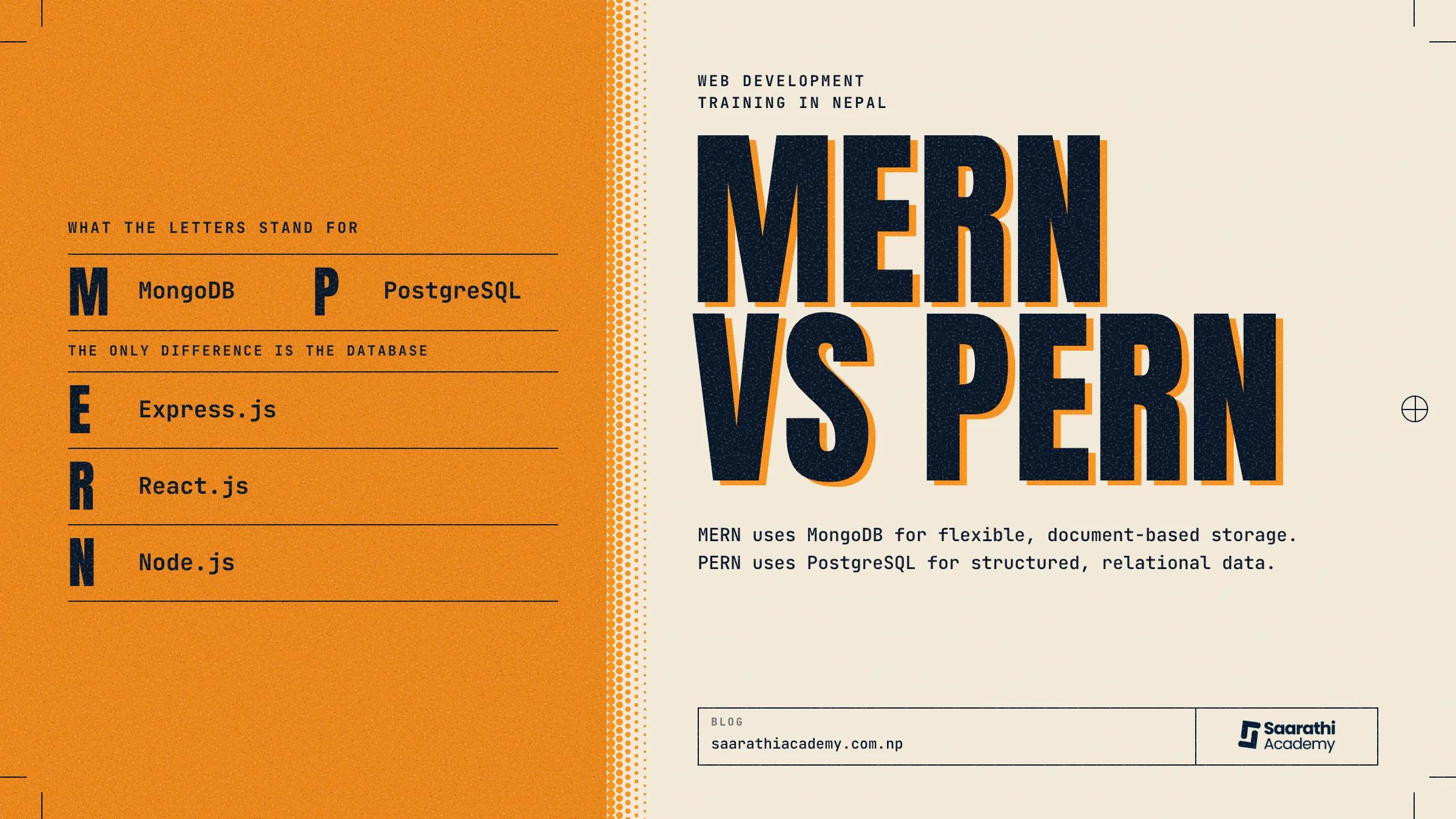
MERN Stack stands for:
M for MongoDB
E for Express.js
R for React.js
N for Node.js
MERN is a JavaScript-only stack, meaning developers write both frontend and backend code in a single language. This makes it beginner-friendly and widely adopted across startups and product companies globally.
MERN stack web development training in Nepal is popular among students who want to build dynamic web applications quickly or work on social platforms, real-time apps, or content-heavy websites.
What Does the PERN Stack Stand For?
PERN Stack stands for:
P for PostgreSQL
E for Express.js
R for React.js
N for Node.js
The only difference between MERN and PERN is the database. PERN replaces MongoDB (a NoSQL database) with PostgreSQL (a relational SQL database). Everything else, Express, React, and Node.js, remains the same.
PERN Stack training in Nepal is gaining traction among developers working on finance, healthcare, and enterprise-level applications where structured, relational data is critical.
MERN Stack vs PERN Stack, Full Comparison
Feature | MERN Stack | PERN Stack |
|---|---|---|
Database Data Structure Best For Learning Curve Scalability Data Relationships Community Job Market in Nepal | MongoDB (NoSQL) Document-based (JSON) Real-time apps, social media Easier for beginners Horizontal scaling Less structured Very large High demand | PostgreSQL (SQL) Table-based (rows & columns) Finance, enterprise, structured data Moderate (SQL knowledge needed) Vertical scaling Strong relational support Growing rapidly Growing demand |
Frontend Development Training with React.js
What Is Frontend Development?
Frontend development refers to everything a user sees and interacts with on a website, including the layout, buttons, forms, animations, and overall user interface. A frontend developer's job is to turn designs into functional, responsive web pages.
Why is React.js used for frontend development?
React.js, developed by Meta (Facebook), has become the dominant frontend library for modern web applications. Here is why it is the preferred choice in both MERN and PERN stacks:
Component-Based Architecture: React breaks the UI into reusable components, making development faster and code easier to maintain.
Virtual DOM: React updates only the parts of the page that change, making apps faster and smoother.
Large Ecosystem: With thousands of libraries, tools, and community resources, React simplifies complex frontend tasks.
High Demand in Nepal: React.js training in Kathmandu is among the most searched IT courses, with companies actively hiring React developers.
Ideal for Single Page Applications (SPAs): React is perfect for building fast, app-like web experiences.
Whether you enroll in MERN stack training in Nepal or PERN Stack training in Nepal, mastering React.js is non-negotiable for frontend development.
Backend Development With Node.js and Express.js
What Is Backend Development?
Backend development is the behind-the-scenes engine of any web application. It handles servers, databases, APIs, authentication, and business logic, everything the user does not see but entirely depends on. A backend developer ensures data flows correctly between the user interface and the database.
Node.js for Web Development
Node.js is a runtime environment that allows developers to run JavaScript on the server side. Before Node.js, JavaScript was limited to browsers. Node.js changed everything.
Here is why Node.js is a pillar of both MERN and PERN stack development:
JavaScript Everywhere, With Node.js, developers use one language, JavaScript, for both frontend and backend, significantly reducing the learning curve.
Non-Blocking I/O: Node.js handles multiple requests simultaneously without waiting, making it extremely fast for real-time applications.
NPM Ecosystem: Node Package Manager (NPM) offers over a million open-source packages, accelerating development speed.
Scalable Architecture: Node.js is ideal for building APIs and microservices that scale with traffic.
High Industry Adoption: Companies like Netflix, LinkedIn, and Uber use Node.js in production, making Node.js training in Nepal a highly valuable career investment.
For anyone pursuing full stack web development training in Kathmandu, Node.js is one of the most critical backend skills to master.
Why Express.js Is Used in Web Development
Express.js sits on top of Node.js and serves as the backbone of the backend in both MERN and PERN stacks. If Node.js is the engine, Express.js is the framework that organizes and controls how that engine runs.
Here is why Express.js is used across virtually every modern JavaScript-based stack:
Minimal and Flexible: Express does not force a specific structure. Developers have full control over how they organize their application, making it lightweight and highly customizable.
Routing Made Simple: Express makes it easy to define routes for handling HTTP requests (GET, POST, PUT, DELETE), which is the foundation of any REST API.
Middleware Support: Express uses middleware functions that process requests before they reach the final route handler. This is essential for authentication, logging, error handling, and data validation.
REST API Development: Both MERN and PERN stacks rely on Express to build RESTful APIs that connect the React frontend to the MongoDB or PostgreSQL database.
Fast Development: Express speeds up backend development significantly compared to building a server from scratch using raw Node.js.
Wide Community and Documentation: Express has one of the largest communities in the JavaScript ecosystem, meaning solutions to problems are always within reach.
In short, Express.js is the glue that holds the backend of both stacks together. Without it, building structured, scalable server-side applications with Node.js would be significantly more complex.
MongoDB vs. PostgreSQL: Choosing the Right Database
MongoDB (Used in MERN Stack)
MongoDB is a NoSQL database that stores data in flexible, JSON-like documents. It is schema-less, meaning you can store different data structures in the same collection.
Best for:
Applications with rapidly changing data structures
Real-time chat apps and social media platforms
Content management systems and blogging platforms
Startups that need to move and iterate quickly
PostgreSQL (Used in PERN Stack)
PostgreSQL is a powerful relational database that stores data in structured tables with rows and columns. It supports complex queries, joins, and transactions, making it ideal for data-integrity-heavy applications.
Best for:
Banking and financial applications
Healthcare management systems
E-commerce platforms with complex product relationships
Enterprise-level applications requiring strict data consistency
Beyond MERN and PERN: The Next.js Full-Stack Approach
MERN and PERN both split an app into a React frontend and a separate Node.js and Express backend server. In 2026, a growing number of teams collapse that split with Next.js, where one app is the frontend and the backend at once. With the App Router, Server Components, Server Actions and Route Handlers, your pages and your API live in one codebase, so there is no separate Express server to build, deploy or keep alive. The database still runs on PostgreSQL, usually through Prisma or Supabase, so the relational side of PERN stays while the Express layer disappears.
This is how Saarathi Academy teaches full-stack web development. Our Full Stack Development with Vibe Coding course builds real web and mobile apps on Next.js, React, TypeScript and PostgreSQL by directing AI tools like Cursor and Claude Code, with a Flutter mobile app that calls the same Route Handlers as the web app. If you specifically want the classic Node.js, Express and NestJS backend path, that is our dedicated Backend Engineering course. So the practical choice in Nepal is less MERN versus PERN and more whether you want one Next.js app that does both, or a separate backend service you build and run yourself.
Which Stack Should You Learn in Nepal?
Both stacks are excellent choices for a career in web development. Here is a simple guide to help you decide:
Choose the MERN stack if:
You are a beginner and want to enter the job market quickly
You want to build real-time or social media applications
You prefer flexible, document-based data storage
You want the largest community and most learning resources
Choose PERN Stack if:
You are comfortable with SQL or want to learn relational databases
You aim to work in finance, healthcare, or enterprise sectors
You want strong data relationships and transaction support
You are targeting backend-heavy development roles
Career Opportunities After Web Development Training in Nepal
Completing a full stack web development course in Nepal, whether MERN or PERN, opens doors to a wide range of career paths:
Full Stack Developer: Work on both frontend and backend systems
Frontend Developer: Specialize in React.js and UI development
Backend Developer: Focus on Node.js, Express, and database management
API Developer: Build and maintain RESTful APIs for web and mobile apps
Freelance Web Developer: Work with international clients through Upwork, Fiverr, and Toptal
Startup Co-Founder: Build your own product using your full stack skills
As per Nepali job portals like Job Dynamics and Kumari Job, the average salary for a junior web developer in Nepal ranges from NPR 25,000 to NPR 50,000 per month, while experienced full stack developers can earn significantly more, especially through remote and freelance work.
Conclusion: Web Development Training in Nepal
Whether you choose MERN Stack or PERN Stack web development training in Nepal, you are making a smart investment in one of the most in-demand skill sets of the digital era. Both stacks share the same powerful trio, React.js, Express.js, and Node.js, differing only in the database layer. The right choice depends on your career goals, the type of applications you want to build, and the industry you want to work in.
Full stack web development training in Kathmandu has never been more accessible or more relevant. With the right training, consistent practice, and real-world project experience, you can build a thriving career as a web developer, locally in Nepal or globally as a freelancer.
Contact us. || Apply Now