Cloud DevOps Training in Kathmandu.
The technology landscape is evolving rapidly, and businesses today must be fast, automated, scalable, and have consistent software delivery. Hence, Cloud DevOps Training in Nepal is one of the most fruitful career choices for IT professionals or students. DevOps provides businesses with a way to optimize their infrastructure and deploy applications more quickly with the help of cloud computing, automation, and deployment practices.
DevOps is a great skill to possess because the demand for DevOps Engineers is increasing globally and in Nepal, and there's a high demand for DevOps-related Cloud and Automation jobs. In this guide, you will learn what DevOps is, why Cloud DevOps is so great, and how you can prepare for a future-ready IT career with Cloud DevOps Training in Nepal.
What Is DevOps? A Simple Explanation for Beginners
Breaking Down the Word
The word DevOps is a combination of the words:
Development: Building and writing software.
Operations (Ops): Deploying that software and keeping it running.
For a long time these two jobs sat in separate rooms. Developers wrote the code and threw it over the wall to the ops team, who then had to deploy it without breaking anything. The result was delays, missed context, failed deploys, security holes, and two teams blaming each other.
What DevOps Actually Does
DevOps is a modern approach to IT that brings together development and operations to focus on the same objective, tools, and culture, all of which work to support continuous improvement. DevOps is a way of working that helps organizations.
Build and release software faster
Enhance the stability and uptime of the system.
Provide updates on a regular basis and in a secure manner.
Deliver updates continuously and safely
Scale infrastructure without chaos
Think of Netflix, Amazon, and Google, which deploy hundreds or thousands of times per day. All is designed at that pace, with that reliability, and it's all based on DevOps principles.
Why Modern Businesses Cannot Function Without DevOps
Today's users require unloading applications, updates in real time, and no downtime. This is not possible with traditional manual work.
Today's software delivery requires:
Continuous Integration (CI): automatically test and merge code changes
Continuous Deployment (CD): automatically deploying tested code to production.
Infrastructure automation: Automation of Servers and environments with Code.
Real-time monitoring: detecting and resolving issues before users notice
Without DevOps, software takes time to deliver, is buggy, and is expensive. It accelerates the speed of teams, decreases the possibility of breaking, and enables teams to bounce back quickly.
What Is Cloud DevOps? Understanding the Connection
Where Cloud Computing Meets DevOps
Cloud DevOps is the combination of cloud computing infrastructure and DevOps engineering practices. These apps are not installed on a physical on-premise server, but rather in the cloud.
The three most dominant cloud platforms today are:
Microsoft Azure
Google Cloud Platform (GCP)
They provide virtual servers, scalable storage, global networking, managed databases, and a wide variety of services. Automation tools and practices are used by DevOps engineers to deploy, manage, and scale apps efficiently in these environments.
Why This Combination Is So Powerful
When cloud computing and DevOps work together, the result is:
Faster, more reliable application deployments
Infrastructure that scales automatically with demand
Lower operational costs through automation
Stronger security through built-in compliance tools
Proactive monitoring and faster incident response
This is exactly why Cloud DevOps professionals are among the most sought-after talent in the global IT industry today.
Why Cloud DevOps Training in Nepal Is Growing Fast
Nepal's Tech Ecosystem Is Expanding
Nepal's technology sector is no longer limited to traditional IT service companies. Today, the landscape includes:
Software product companies
International outsourcing firms
Fintech and SaaS startups
E-commerce platforms
Cloud-based service providers
As these businesses scale, they need professionals who understand cloud infrastructure, CI/CD pipelines, automation, and secure deployments. The gap between demand and supply creates a meaningful opportunity for learners who get started now.
Global Demand, Local Talent
One of the biggest advantages of DevOps skills is that they are globally transferable. Cloud infrastructure is borderless a DevOps engineer trained in Nepal can work for:
Nepalese technology companies
International remote engineering teams
Freelance cloud consulting clients anywhere in the world
Remote work has changed the equation dramatically. Strong DevOps skills no longer just compete locally they compete globally.
The Skills Gap Is Real
Yet, there are precious few people who have the real-world expertise to practice DevOps. The majority of IT graduates are well-versed in theory but not in practical knowledge of how pipelines are used in a real sense. This leads to a real competitive edge for those who invest in practical and structured DevOps training early on.
Core Skills You Will Build in Cloud DevOps Training
A good Cloud DevOps course teaches a series of skills that are progressively added, starting from basic system knowledge to advanced system automation and cloud engineering.
Linux and System Administration
Linux powers the vast majority of cloud servers and production environments. Before touching any cloud platform or DevOps tool, you need a solid Linux foundation. This includes:
Essential command-line skills
File systems and user management
Server administration
Shell scripting for automation
Version Control with Git
Software collaboration at scale requires version control. Git is the industry standard, and understanding it deeply is non-negotiable for any DevOps role:
Repository creation and management
Branching and merging strategies
GitHub/GitLab workflows
Code collaboration best practices
Cloud Computing Fundamentals
You will get hands-on experience with major cloud platforms, covering:
Cloud architecture and design principles
Virtual machines, networking, and storage
Identity and access management (IAM)
Cloud security and cost management
CI/CD Pipeline Automation
Continuous Integration and Continuous Deployment are the heartbeat of modern software delivery. You will learn to:
Set up automated testing pipelines
Build deployment workflows with tools like Jenkins, GitHub Actions, or GitLab CI
Eliminate manual deployment steps
Reduce release failures and deployment downtime
Containerization with Docker and Kubernetes
Containers have transformed how applications are built and run. This section covers:
Docker: packaging applications into portable, consistent containers
Kubernetes: orchestrating containers at scale across cloud environments
Kubernetes expertise in particular is one of the most valued and well-compensated skills in cloud engineering today.
Infrastructure as Code (IaC)
Infrastructure as Code is the practice of managing servers, networks, and cloud resources using code, not manual configuration panels. Tools covered include:
Terraform: for provisioning cloud infrastructure
Ansible: for configuration management and automation
This approach eliminates human error, ensures consistent environments, and makes scaling infrastructure dramatically easier.
Who Should Learn Cloud DevOps?
Cloud DevOps training is designed for a wide range of learners, not just experienced engineers.
Ideal candidates include:
Computer engineering and IT students
Software developers looking to expand their skills
QA and testing engineers transitioning into automation
Network and system administrators are modernizing their skill set
Cybersecurity learners interested in cloud security
Fresh graduates entering the job market
Working professionals ready for a career upgrade
Can Beginners Start With DevOps?
Absolutely. Beginners can thrive in DevOps with the right structured program. A beginner-friendly course starts with Linux fundamentals, basic networking, cloud concepts, and simple scripting, then gradually introduces automation, pipelines, containers, and cloud infrastructure. The key is consistent hands-on practice, not just passive theory.
Career Opportunities After Cloud DevOps Training
Cloud DevOps Training in Nepal opens the door to some of the most in-demand IT careers in today’s technology industry. As companies increasingly adopt cloud infrastructure, automation, and CI/CD pipelines, the demand for skilled DevOps professionals continues to grow rapidly.
After completing a DevOps course, learners can pursue roles such as:
DevOps Engineer: manages automation workflows, CI/CD pipelines, and deployment processes
AWS Cloud Engineer: handles cloud infrastructure and cloud-based application deployment
Site Reliability Engineer (SRE): ensures system stability, uptime, and performance optimization
Cloud Infrastructure Engineer: designs scalable and secure cloud environments
Platform Engineer: builds internal platforms and developer automation systems
Kubernetes Administrator: manages containerized applications and orchestration systems
Automation Engineer: automates testing, deployment, and infrastructure management
Because modern businesses rely heavily on cloud computing and automation, Cloud DevOps professionals are becoming highly valuable across startups, enterprises, and international remote companies.
Why DevOps Roles Are Well Compensated
DevOps engineers directly impact a company's ability to ship products, retain customers, and stay competitive. When systems go down or releases fail, businesses lose money. DevOps professionals are the people who prevent that, and who fix it quickly when it happens.
Because the business impact is so direct and measurable, DevOps roles consistently rank among the highest-paid positions in the technology industry.
Why 2026 Is the Right Time to Start
The Industry Shift Is Already Happening
Manual IT processes are disappearing. Cloud-native architecture, infrastructure automation, and continuous delivery are becoming baseline expectations, not advanced specializations. Companies are not waiting for this transition; they are already living it.
Early Starters Gain a Lasting Advantage
The supply of skilled DevOps talent continues to lag behind demand. Students and professionals who build real, demonstrable expertise now will enter a job market where they are genuinely scarce and therefore, genuinely valued.
Timing matters in technology careers. The learners who act early become the senior engineers, team leads, and cloud architects of tomorrow.
Why Choose Saarathi Academy for Cloud DevOps Training in Nepal
Learning That Goes Beyond Theory
Saarathi Academy's approach to Cloud DevOps training is built around practical, hands-on implementation. Students do not just watch demonstrations; they build real pipelines, manage live cloud environments, and work through the kind of problems that actual DevOps engineers face every day.
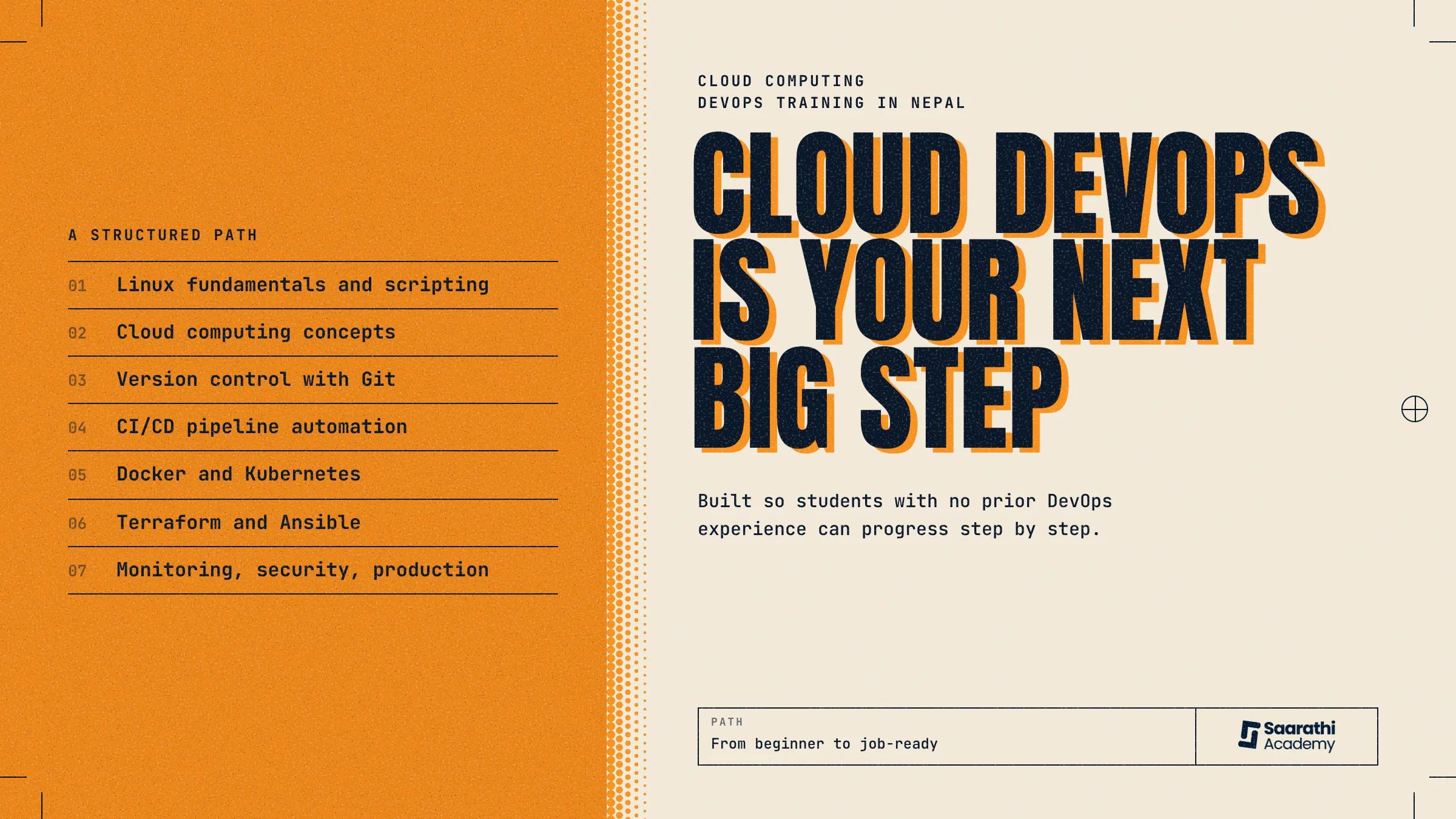
A Structured Path From Beginner to Job-Ready
The curriculum is designed to meet learners where they are and progress them systematically:
Linux fundamentals and scripting
Cloud computing concepts and architecture
Version control and collaboration with Git
CI/CD pipeline design and automation
Containerization with Docker and Kubernetes
Infrastructure as Code with Terraform and Ansible
Monitoring, security, and production readiness
This progression ensures that even students with no prior DevOps experience can build confidence and capability step by step.
Career-Focused Outcomes
The goal at Saarathi Academy is not simply to hand you a certificate; it is to prepare you for real employment. Students graduate with practical project experience, exposure to industry-standard tools, and the problem-solving confidence that employers look for in entry-level and mid-level DevOps roles.
If you want to know more about the course details, price structure, syllabus, and other details about Cloud DevOps training, you can visit our
cloud computing and devops course in nepal
Conclusion
DevOps is not a trend; it is the foundational shift in how modern software is built, deployed, and maintained. As cloud computing continues to replace traditional infrastructure, and as automation continues to replace manual processes, skilled DevOps engineers will only become more essential.
For learners in Nepal, Cloud DevOps Training offers a rare combination of global demand, growing local opportunity, and the kind of practical skills that translate directly into career results.
The industry is growing. The demand is real. The opportunity window is open. What you do with it now will shape where your career is in three, five, and ten years from today.