
The Rise of Ethical Hacking in Nepal
Cyber attacks in Nepal are on the rise, yet there is still a threat of a short supply of professional people in cybersecurity.
Each week, Nepali banks, governmental websites, e-commerce companies, and startups are under attack, and the majority of organizations are in no way ready to deal with these security threats.
You are asking the right question at the right time. Should you be thinking of training in ethical hacking in Nepal? You have a right to know the honest and straightforward answer to anything you are signing up for before you are given a sales pitch in the guise of guidance.
The Truth About Ethical Hacking - Not What You Think
Many people assume ethical hacking is quick to learn and easy to monetize. In reality, building real skill through ethical hacking training in Nepal takes time, consistency, and deep understanding.
Key Realities:
It takes months - often years of consistent practice to become skilled
Tools don’t make you an expert - your thinking does
Ethical hacking is not shortcut money - it’s a serious, high-skill career
Real learning comes from understanding systems, not just running commands
Ethical hacking is more of an attitude than equipment. Those who survive are those who remain curious, think hard, and never give up on how and why things work.
Why Ethical Hacking Training in Nepal Is Suddenly in Demand
Nepal's Rapid Digital Transformation
The digitalization of Nepal is faster than the cybersecurity workforce can handle. The major areas of this change are:
Online banking and fintech: billions of transactions are being processed every day with little security supervision.
Digitization of government: online portals and citizen data systems are becoming more and more common.
Startups and e-commerce: develop quickly, frequently, without specific security teams.
All the new digital systems that have been added to the ecosystem are a new source of vulnerability, and most of them are being developed without proper security knowledge.
A Visible and Growing Skills Gap
Talk to any IT manager in any Nepali organization, and the majority of them will confirm the same: that the lack of skilled cybersecurity professionals is a reality, and it is increasing. The issue is that companies are at risk not due to a lack of care but due to the unavailability of trained talent. That separation is a real, long-lasting career need of anybody prepared to invest in creating the appropriate abilities.
Access to Global Opportunities
The opportunity does not stop at Nepal's borders. Cybersecurity is one of the few technology disciplines where remote work demand is genuinely strong globally. Skilled ethical hackers from Nepal are increasingly finding:
Freelancing income on international platforms
Remote contracts with foreign companies
Full-time international roles as the field gains global recognition
Nepal's cybersecurity industry is still in its early stages. The professionals who build strong foundations now will carry the biggest advantage as the market matures.
What You Will Actually Learn - A Deep, Honest Breakdown
This is where most training programs fail their students. They list tools without explaining the reasoning behind them. Here is what a genuinely structured, skill-building curriculum should cover.
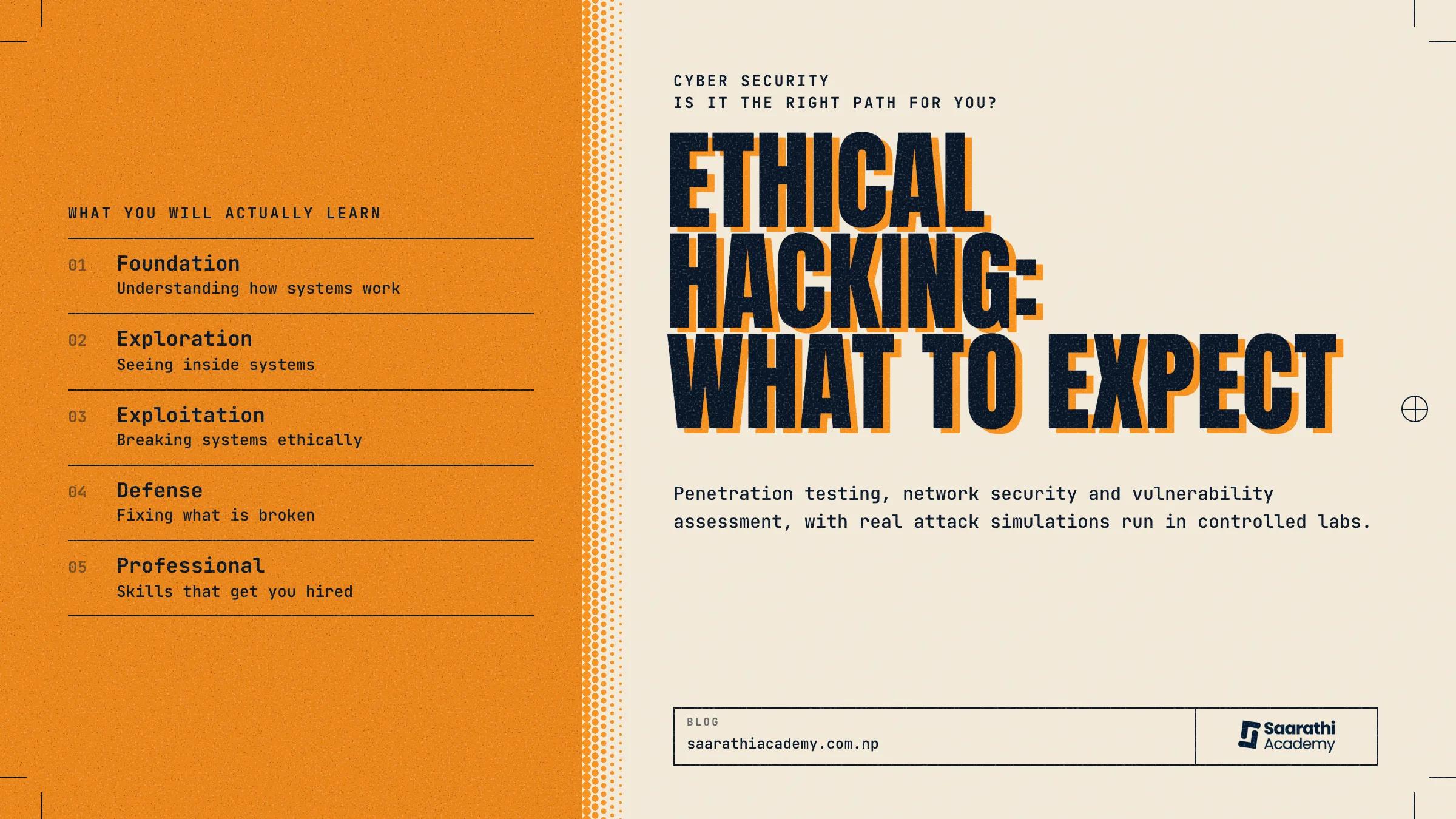
1. Foundation Layer - Understanding How Systems Work
Before you can test a system, you have to understand it deeply. This layer includes:
Networking fundamentals - TCP/IP, DNS, and how data travels across networks
Operating system basics - Windows and Linux at a level most general IT learners never reach
Understanding how client - server communication actually works
You cannot hack what you do not understand.
2. Exploration Layer - Seeing Inside Systems
At this stage, you learn to observe and interpret what is happening inside a network. Key skills include:
Scanning networks to identify active devices and open services
Analyzing traffic patterns to detect anomalies
Understanding what normal system behavior looks like versus what looks suspicious
The real skill here is not running a tool - it is knowing what the output actually means.
3. Exploitation Layer - Breaking Systems Ethically
This is the phase that attracts most people to the field. You will work through:
Web vulnerabilities: SQL injection, cross-site scripting (XSS), broken authentication
System weaknesses: misconfigurations, privilege escalation, and unpatched services
Real attack simulations: conducted entirely in controlled lab environments
All exploitation practices are done ethically, in sandboxed environments, with no risk to live systems.
4. Defense Layer - Fixing What Is Broken
Ethical hacking does not end with finding a vulnerability. It ends with closing it. This layer teaches you to:
Patch and harden vulnerable systems
Implement access controls and network defenses
Prevent the same attack from succeeding a second time
5. Professional Layer - Skills That Get You Hired
This is what separates a technically capable person from a hireable professional. You will learn:
How to write clear, structured vulnerability reports
How to explain technical risk to non-technical decision-makers
How to present findings in a way that drives real action from clients and employers
Real ethical hackers are not just attackers. They are problem solvers.
The Hard Reality - Why Many Students Fail
This needs to be said clearly, because too many students waste both time and money learning this the hard way.
Most students who struggle in ethical hacking fail for three consistent reasons:
Inconsistent practice: engaging heavily when motivated, then dropping off when things get difficult
Tool obsession without understanding: running scans and scripts without knowing what the results actually mean
Lack of real hands-on exposure: watching tutorials instead of building in actual lab environments
Watching a video is not practice. Reading about vulnerabilities is not a practice. Only working through real scenarios, making mistakes, and understanding why something failed - that is what builds skill.
Ethical hacking is not difficult because of the tools involved. It is difficult because it demands deep, sustained thinking.
Who Should - and Should Not - Choose Ethical Hacking
This Path Is Right for You If:
You are genuinely curious about how systems work beneath the surface
You are pleased to know the answer to complicated situations that are not immediately visible.
You are ready to practice regularly, even when you feel it is not progressing.
You are patient enough to get the basics solid and then proceed to more complicated things.
This Path Is Not Right for You If:
You are primarily motivated by shortcuts to a high salary
Sitting with a difficult, unsolved problem for hours feels unbearable rather than interesting
You want a certificate for appearance rather than the knowledge it should represent
This is not gatekeeping; it is respect for your time and investment. This is one thing that you can learn truthfully and at a young age, so that you can save yourself months of frustration and also help yourself find a technology route that truly suits you.
Ethical Hacking Career in Nepal - A Realistic Perspective
Where the Market Stands Today
The cybersecurity job market in Nepal is growing steadily, but competition is increasing alongside it. At this stage of the market, demonstrated skills carry far more weight than course certificates alone.
What Actually Gets You Hired
You will not land a cybersecurity role on the strength of a certificate alone. What moves the needle in hiring is:
A portfolio of completed Capture the Flag (CTF) challenges
Documented lab exercises with clear problem-solving write-ups
The ability to walk an interviewer through your technical approach with confidence
The Income Reality
Starting salaries in cybersecurity may be modest initially
Growth is significant for professionals who keep developing their skills
Senior professionals - especially those working remotely for international clients - are among the best-compensated individuals in the entire IT industry
The early investment of time and effort pays serious dividends over a career.
Typical Training vs. The Saarathi Academy Approach
The ethical hacking training in Nepal does not produce the same outcome. As much as most institutes aim at completing a syllabus, it is the effectiveness with which you develop job-ready skills that matters.
Key Differences:
Learning Focus
In the typical institutes, the main focus is on theory-based lectures, but Saarathi focuses on practical learning during the first day.Practice Opportunities
Many programs offer little to no real practice. Saarathi provides structured labs and real-world scenarios.Batch Size
Large groups (30–50 students) often limit interaction. Saarathi keeps batches small for focused learning.Mentorship
Standardized learning versus individualized teaching, feedback, and assistance.Outcome
The majority of courses are finished by a certificate. Saarathi is dedicated to developing job-ready skills.
Most students do not fail because they lack access to courses. They fail because they lack access to meaningful, practical exposure.
What to Expect from a High-Quality Cybersecurity Course in Nepal
A program worth your investment should deliver across three dimensions.
Learning Experience:
Labs with practical simulations of real attack and defense scenarios in the first week.
Progressive development of basics to higher-level concerns.
Assessments that are frequent and concentrate on application rather than memorization.
Learning Environment:
Small groups in which your teacher is familiar with your progress.
Live mentoring and on-the-fly feedback about your work.
A group of serious learners towards the same objectives.
Tangible Outcome:
The confidence to attempt real-world security challenges independently
A portfolio that demonstrates your capability to employers
A clear, defined path forward into employment or freelance work
Why Your Learning Environment Matters More Than the Syllabus
Here is something course brochures will never tell you: the syllabus at most cybersecurity training programs in Nepal is nearly identical.
The distinction between truly competent graduates and otherwise nearly always depends on the manner in which they were taught, rather than what they were taught.
Consider the difference between:
A group of 50 students with two hours of lab time, together with no personal feedback.
A team of 10 students solving problems under the guidance of a mentor in real-time.
Want to explore our Ethical Hacking courses in detail?
Visit Saarathi Academy to learn about course duration, fee structure, syllabus, practical training, certifications, and career opportunities in Cybersecurity & Ethical Hacking.
Is Ethical Hacking Training in Nepal Worth It? - A Decision Framework
Put the opinions aside. Ask yourself these three questions honestly:
Do I genuinely enjoy working through complex technical problems?
Am I willing to practice daily, not just when I feel motivated?
Can I stay patient through months of building fundamentals before the advanced material opens up?
When you can be honest with yourself in all three - go, go on. Training in ethical hacking in Nepal is well worth it for the right person, and the time to do it could not be better.
No to one or more of these - that is not a failure. It is good self-knowledge. There is a much greater likelihood that strong technology careers in software development, data and cloud infrastructure, and IT support are a much better fit at this point in your career.
Conclusion
The opportunity in cybersecurity is real, and it is growing. Nepal's digital economy is expanding faster than its security workforce, and that gap will not close on its own.
To set yourself up for success:
Start with fundamentals and build steadily upward, do not skip steps
Prioritize daily, active practice over passive content consumption
Choose your training environment carefully, look for small batches, real labs, and genuine mentorship
At Saarathi Academy, that is exactly what drives how we teach: real-world skills, structured hands-on practice, and mentorship that moves you forward not just toward a certificate, but toward a career that lasts.
The field is open. The timing is right. The only question is whether you are ready to build something real.
Choose Saarathi Academy to Start Your Cybersecurity Career Today.