
Nepal’s digital economy is rapidly shifting toward product-driven innovation, and this change is fueling the rise of UI/UX Training in Nepal. What was once seen as a secondary design skill is now a core business requirement, as companies realize that good user experience drives real success.
Across Kathmandu and other growing tech hubs, the demand for professionals with UI/UX Training in Nepal is increasing faster than the available talent. This article explores what’s behind this growth, why many learners still struggle to get hired, and what it means for your career in 2026.
Nepal's Digital Economy Has Changed: UI/UX Is a Direct Result
UI/UX demand is not a standalone trend. It is a symptom of deeper economic change happening within Nepal's tech landscape. To understand the opportunity, you need to understand the shift.
Product-Based Thinking Is Emerging
A growing number of Nepali startups are now building apps, SaaS platforms, and digital services, not just delivering client work. This transition from "client work" to "user-focused products" fundamentally changes what teams need. Client work needs coders who execute. User-focused products need designers who think.
User Expectations Have Skyrocketed
Nepali users are no longer first-time smartphone owners discovering apps. They are daily users of Netflix, Airbnb, Google Pay, and globally polished digital experiences. Their expectations have been calibrated to world-class standards. They now expect smooth flows, clean interfaces, and fast experiences from every app, including yours.
Design Has Become a Revenue Function
Poor UX directly translates to drop-offs, churn, and lost revenue. Forward-thinking companies in Nepal have begun connecting design decisions to business outcomes, investing in UX to increase conversions and improve user retention. When design becomes measurable in revenue terms, it becomes a hiring priority.
UI/UX is directly tied to business performance not just aesthetics or visuals. This is why companies are hiring, and why UI/UX training in Nepal is surging in 2026.
The Real Reason Demand Is Exploding: And Why Supply Isn't Keeping Up
Here is the uncomfortable truth behind Nepal's UI/UX boom: there are plenty of learners, but very few hireable designers. Demand is high. Qualified talent is scarce. The gap is widening, and it has a very specific cause.
The Tutorial Trap
Most people who say they are "learning UI/UX" are doing the following: watching Figma tutorials on YouTube, copying Dribbble aesthetics, and posting polished-looking screens. None of that is UI/UX design. It is software mimicry. Without real problem-solving, there is no design thinking, and without design thinking, there is no value to offer an employer.
Watching Figma tutorials without building real products
Copying Dribbble screens without understanding the "why."
Building portfolios of redesigns with no research or user flow depth
Learning tools instead of learning how to think like a designer
Market Truth: Companies are not hiring "UI/UX learners." They are hiring decision-makers who can think like product designers, people who connect user problems to business solutions through design.
Traditional Training vs. Industry-Ready Training
Not all UI/UX Training in Nepal leads to employable skills. The difference between traditional training and industry-ready programs directly impacts career outcomes.
Typical Training Institutes
Lecture-based, passive learning approach
Focus mainly on tools like Figma
Generic, template-based assignments
Minimal or no structured feedback
Large batch sizes (20–50+ students)
Outcome limited to a course completion certificate
Industry-Ready Training
Practice-driven, active learning environment
Strong emphasis on UX thinking and problem-solving
Real-world, scenario-based project work
Continuous mentorship and iterative feedback
Small, controlled batches for personalized learning
Outcome includes portfolio development, confidence, and career readiness
The effectiveness of UI/UX Training in Nepal depends not on completing lessons, but on developing practical skills that align with real industry expectations.
What real UI/UX Training Actually Looks Like
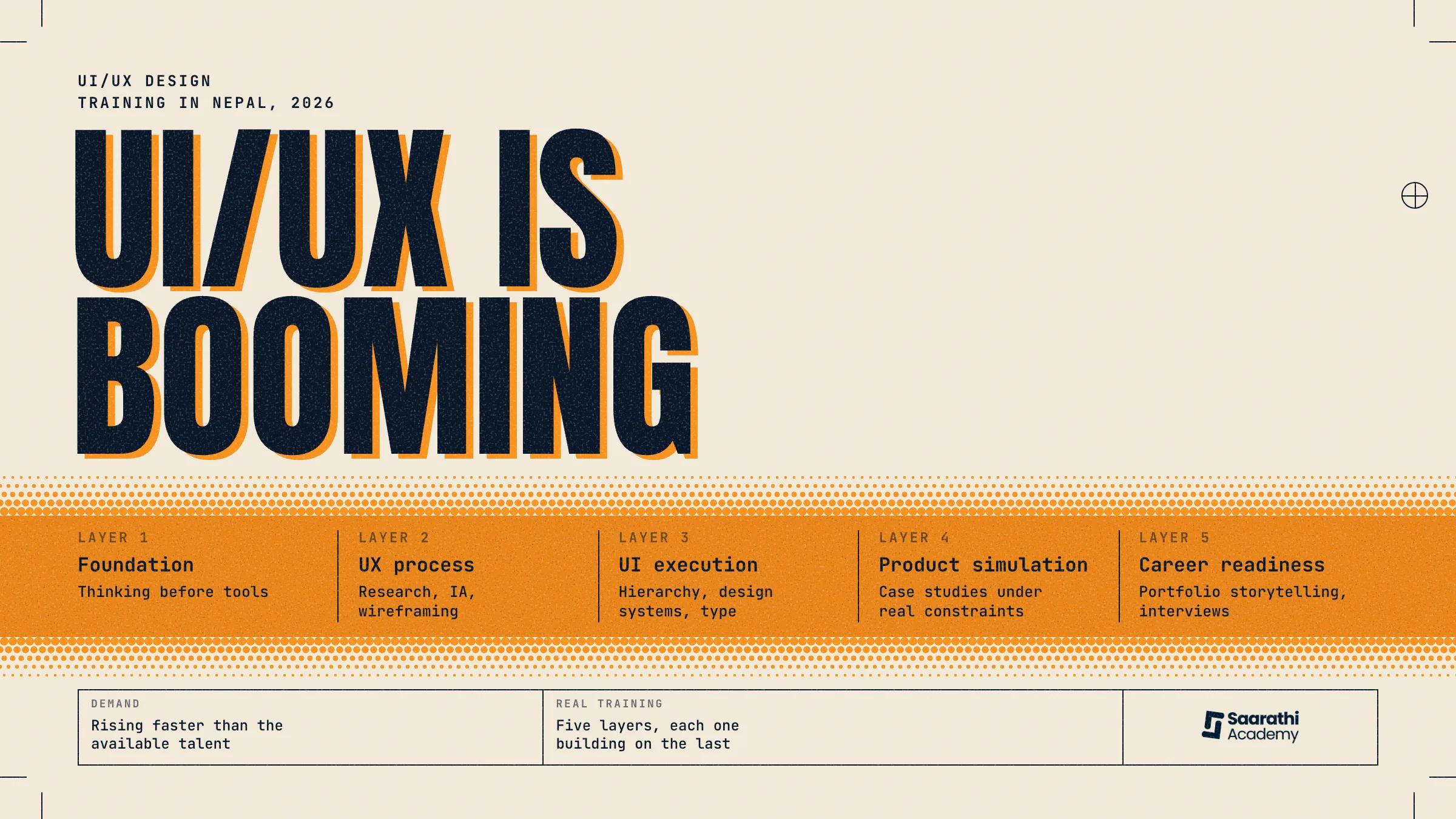
There is a prevailing illusion in the market that a short UI/UX course can make you job-ready. It cannot. Real, industry-aligned UI/UX training in Nepal must cover five distinct layers, each one building on the last.
Foundation: Thinking Before Tools
Design psychology, human behavior, cognitive load, and interaction patterns. Before you open Figma, you need to understand how people think.
UX Process
Problem definition, user research (practical and applied), information architecture, and wireframing logic grounded in real user needs.
UI Execution
Visual hierarchy, design systems, typography, color theory, and accessibility basics, the craft layer that makes UX decisions visible.
Product Simulation
End-to-end case studies under real constraints, time, user personas, business goals. This is where learners become designers.
Career Readiness
Portfolio storytelling, interview articulation, freelance positioning, and the ability to communicate design decisions, not just show them.
What an Industry-Aligned Training Approach Looks Like
The characteristics that define genuinely effective UI/UX training are not complicated, but they are rare. Here is what to look for when evaluating any UI/UX course in Nepal:
Small batch model (max 10 students): Enables real, individual feedback. Prevents passive learning. Forces participation.
Learning filter at entry: Not everyone learns the same way. Quality programs assess learning style and set direction accordingly.
Real project-based training: Not "practice tasks" or template exercises, simulated real product problems with constraints.
Mentorship over teaching: Continuous correction and design thinking refinement, not one-way content delivery.
Career readiness as a measurable outcome: Portfolio over certificate. Communication training included. Interview preparedness built in.
The goal of effective UI/UX training is not to complete a course. It is to become employable to build a portfolio you can defend in an interview and an articulation that convinces a hiring manager you think like a product designer.
Career Reality: What Happens After UI/UX Training?
After completing the right UI/UX Training in Nepal, career opportunities extend far beyond entry-level roles. Designers can move into positions such as:
UI Designer
UX Designer
Product Designer
UX Researcher
Freelancer (global projects)
Remote Designer
Design Consultant
At the entry level, UI Designers focus on visual execution and working with developers. UX Designers go deeper into user research and problem-solving, while Product Designers combine both and play a key role in building successful digital products.
Freelancing and remote work further expand opportunities. With a strong portfolio and communication skills, professionals with UI/UX Training in Nepal can compete in the global market, not just locally.
Getting your first job is not the hardest part. Becoming consistently valuable is. The designers who invest in genuine skill development not just certificates they are the ones who grow fastest.
Timing Advantage: Why 2026 Is a Critical Window
The growth of UI/UX Training in Nepal has created a clear timing advantage in 2026. Demand for skilled designers is rising quickly, while the supply of truly job-ready talent remains limited. At the same time, competition is still lower compared to more saturated roles like development, creating a valuable but temporary opportunity.
Early entrants benefit the most. They build stronger portfolios while expectations are still evolving, gain real-world experience faster, and progress into higher-level roles sooner. Over time, this also helps them establish networks and credibility that compound.
Late entrants, however, will face a more competitive market with higher standards and fewer opportunities to learn on the job.
How to Choose the Right UI/UX Training in Nepal
Choosing the wrong training does not just waste money; it delays your career by months or years. Before enrolling in any UI/UX course in Nepal, ask these five questions directly:
Will I build real case studies, not templated exercises, that I can present in an interview?
Will I receive direct, individual feedback from a mentor who reviews my actual work?
Is the batch size controlled to enable personalised learning and real interaction?
Will I graduate with a portfolio I can confidently defend, not just a certificate to show?
Does the program include training on communicating design decisions, not just producing them?
Conclusion
Let us be direct about where things stand in Nepal's UI/UX landscape in 2026.
UI/UX is not saturated; it is underdeveloped. The demand is real. The opportunity is real. The jobs exist and will continue to grow as Nepal's digital product economy matures. But the outcome for any one person in this market depends on three things: the quality of training, the depth of practice, and the willingness to think rather than just learn tools.
The designers who will lead Nepal's next generation of digital products are not the ones who completed the most courses; they are the ones who built the most, received the most honest feedback, and developed the most genuine understanding of user needs