Call three institutes in Kathmandu and ask the price of a cybersecurity course. One might say NPR 9,000 and another NPR 80,000, and neither will tell you why the numbers are so far apart.
We teach cybersecurity training in Kathmandu, along with ethical hacking, at Saarathi Academy in Old Baneshwor. Most of our batches include a few people who already paid for a cheaper course elsewhere. They can name Nmap, Burp Suite and Metasploit. What they have never done is write up a finding, and no one has ever pointed out that something they found was a false positive.
Closing that gap is most of what a course fee should buy.
Below we look at the 2026 cost of cybersecurity training near Kathmandu, what each price level gets you, where free material runs out, and seven questions to ask before you pay anyone.
What does "affordable" actually mean?
A low fee for a course that teaches you nothing is money lost slowly. A better way to judge it: the course is affordable if, 6 to 12 months after you finish, you are able to apply for paid security work with real evidence of your skills.
People tend to compare tuition and nothing else. Three other costs usually get left out:
Exam fees are usually separate. The vendor, not the institute, charges for international certificates, and it charges in US dollars. CompTIA Security+ is around USD 425, eJPT about USD 250, and OSCP starts near USD 1750. When a course says "certification included", ask which certificate it means and who pays for the exam.
Your laptop is part of the cost. Expect to run virtual machines for hours. Kali Linux with a target machine beside it needs 16 GB of RAM or more to run smoothly. On an 8 GB laptop, budget for more memory or use the lab computers at the institute.
The expensive mistake is paying twice. Spend NPR 12,000 on a course that doesn't make you job-ready, then a NPR 35,000 course that actually teaches you, and you have spent NPR 47,000. This is how most Nepali learners end up overspending on security training.
Before comparing any prices, decide which job you are aiming for. Ethical hacking and cyber security lead to different roles. If you're not sure how they differ, read the difference between ethical hacking and cyber security before anything else.
Affordable cyber security training in Kathmandu
These are the 2026 costs for certification training near Kathmandu, from free options up to a full career course.
Type of training | Fee | Time | Lab practice | Certificate |
YouTube and free sites | Free | Your own pace | You set it up | None |
Coursera, Google certificates | NPR 4,000 to 15,000 | 3 to 6 months | Simulated only | Platform certificate |
Short local bootcamp | NPR 10,000 to 25,000 | 4 to 8 weeks | Limited | Attendance slip |
Full career course | NPR 30,000 to 45,000 | 3 months | Full VAPT lab | Proctored exam + project |
Foreign certificate, self-study | USD 250 to 1,750 exam only | Varies | You arrange | Vendor certificate |
About these figures: the ranges for other institutes are our estimates from prices advertised publicly in the Kathmandu Valley. Prices and discounts change often, so call and check before paying anyone, us included.
Our own cybersecurity course in Nepal lists at NPR 36,750, and the course page shows any current offer. The fee covers 12 weeks, about 120 hours of practical lab time, a capstone project, and a certification exam that is proctored. Security+, eJPT and OSCP exam fees are not included. You pay those to the vendor in USD if and when you decide to take them.
Can you learn free cyber security training in Nepal?
Yes, and you can get further than most people think.
Much of the free material is good. Coursera and GeeksforGeeks cover theory well. The Web Security Academy from PortSwigger is the strongest free web application course we know of, and PortSwigger can give it away because it sells Burp Suite. OWASP Juice Shop is an app built to be broken, so you can practise attacks on it. HackTricks is the reference that working pen testers keep open while they work.
With discipline and enough time, you can build real skill without paying for a course, and some people do.
Free learning runs out in three places.
No one helps when you're stuck. Say your Kali virtual machine can't see the target network. Alone, that can eat four days. In a Sunday lab it takes about ten minutes to sort out.
No one checks your work. At some point you'll find what looks like a serious vulnerability and turns out to be a false positive. With no reviewer, you won't catch it, and it ends up in a report or an interview answer.
No one can verify what you learned. A bank's hiring manager has no way to check your YouTube history. A proctored certificate ID and a report you wrote are things they can check.
For most people a mix works best. Get the fundamentals from free sources, and pay for what needs a person: fixing lab problems, reviewing reports and preparing for interviews.
If you're going the free route, start with the tools. Free labs mostly use the same toolchain as paid courses, so the time is not wasted. Our guide to cyber security tools for beginners covers which tools to set up first and the order to install them in.
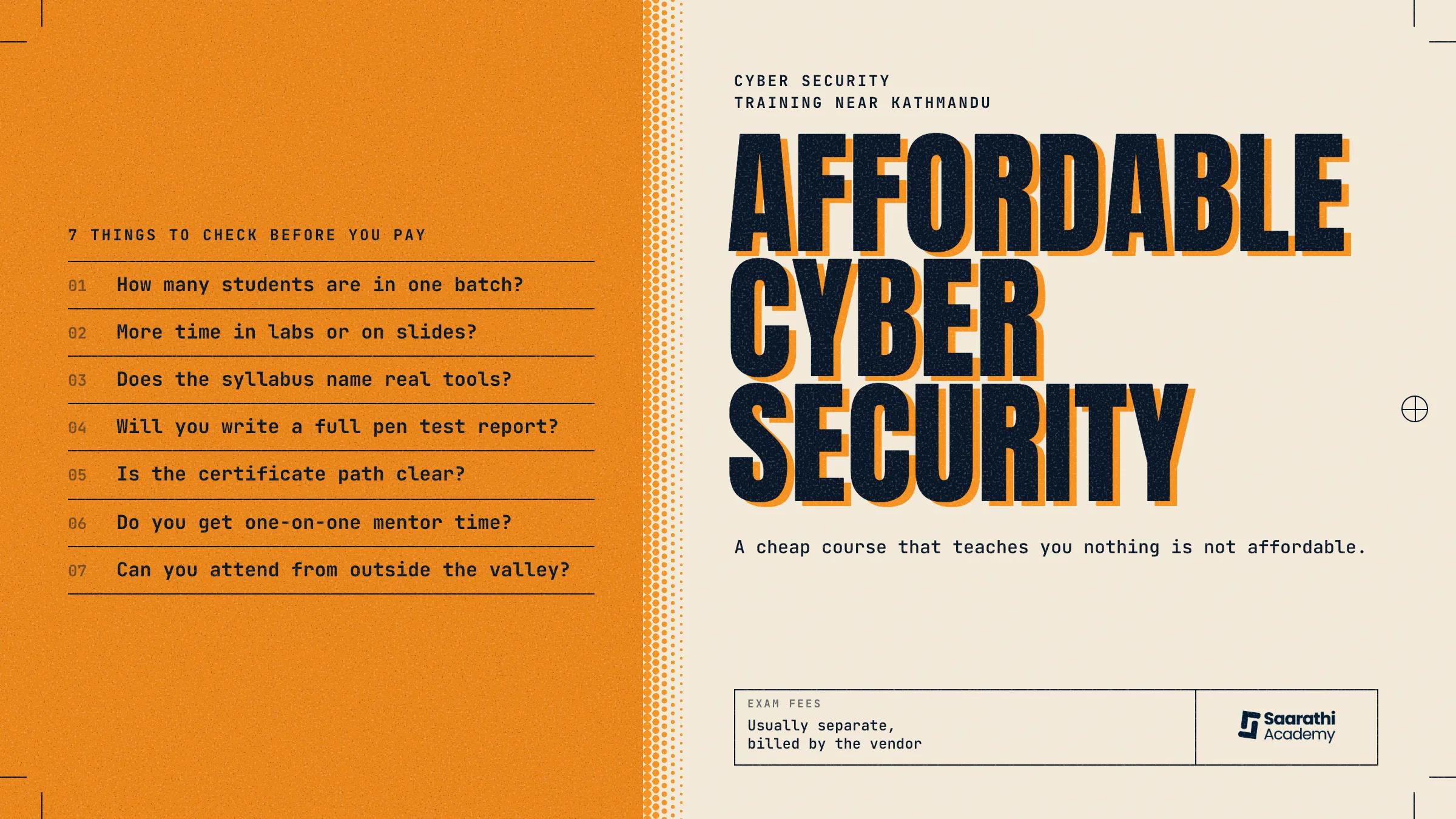
7 things to check before you pay
We'd ask each of these at any institute, ours included.
1. How many students are in one batch?
A batch of ten and a batch of forty at similar fees are not the same course. With forty people, the trainer demonstrates and you watch. With ten, the trainer can come to your desk and look at your terminal when a scan comes back empty. Ask for the maximum batch size in writing. A vague reply tells you enough.
2. Do you spend more time in labs or on slides?
Ask what share of each class is practical work. Then ask if you can watch one session before deciding. An institute that trusts its teaching will say yes.
3. Does the syllabus name real tools?
A proper syllabus lists them: Kali Linux, Nmap, Wireshark, Burp Suite, Metasploit, SQLMap, Nuclei and OpenVAS. Methods belong there too, such as the OWASP Top 10, the OWASP API Top 10 and CVSS v3.1. If all it says is "advanced hacking techniques", you're reading an advert.
4. Will you write a full penetration test report?
This one question tells courses apart. Finding a bug is the enjoyable part, and it is the smaller part. The work is proving the bug, rating how severe it is, explaining what it means for the business and showing a developer how to fix it. Many juniors in Nepal know how to run a scanner. Few can write a report that a client would pay for. A course that never gets you to a finished report leaves out the part employers hire for.
5. Is the certificate path clear?
A good course explains where its certificate fits and what you'd take after it. For a beginner, a sensible order is CompTIA Security+ for fundamentals, eJPT to show you can test in practice, and OSCP later once you have some experience.
Watch for one thing here. An institute certificate shows you finished that institute's course. A vendor certificate shows you passed an exam set by someone independent. Both have value, but they are different, and an institute that mixes them up is misleading you.
6. Do you get one-on-one mentor time?
Teaching a group covers technique. A one-on-one review is where your own bad habits get noticed. Ask if mentor reviews are on the timetable or only "on request", because on request usually means they rarely happen.
7. Can you attend if you live outside the valley?
Lots of courses now offer live online classes next to the in-person ones, often for less. Our live online seat costs less than the classroom one, and the course page shows both fees. If getting to Kathmandu is the problem, ask about this before you cross a course off your list.
What a 12-week cybersecurity course in Nepal actually covers
Security training works best in a set order. This is the order we teach, and the reason for it.
Weeks 1 to 4: security mindset, networking and recon. First you learn what you may and may not touch. After that come how networks work, reading traffic in Wireshark, and finding hosts and services with Nmap.
Weeks 5 to 7: host review and web testing. Hardening Linux, reading logs, and where your evidence ends up in a SOC. Next, how a web application is put together, one layer at a time, before you attack it. Then the OWASP Top 10 using Burp Suite.
Weeks 8 to 9: API testing and exploitation. JWT attacks, broken object-level authorisation, SSRF, XXE, GraphQL testing and insecure deserialization. Most bugs in modern apps are found here.
Weeks 10 to 12: SOC work, reporting and career prep. SIEM and Tier-1 SOC practice, CVSS scoring, writing fixes, structuring a capstone report, and finally a CV review and a mock interview.
There is a reason for this order. You can't test a web application properly without understanding the network and operating system it runs on. Students who start with "hack a website" in the first week learn to follow steps but can't explain what they found.
For a fuller month-by-month plan, including what to study between courses, read our cyber security learning roadmap for beginners in Nepal.
You can also download the detailed syllabus and put it side by side with any other course you're looking at.
What are the cybersecurity jobs in Nepal after training?
After a solid three-month course, these are three realistic first jobs:
Junior VAPT analyst. You test web apps and APIs for weaknesses, confirm what you find and write it up. Security consultancies and bigger fintech firms hire for this.
Tier-1 SOC analyst. You watch security alerts, look into anything suspicious and pass real incidents up the chain. Banks and managed service providers hire for this, and it is often shift work.
Application security analyst. You sit with developers, check code and designs for security flaws, and help fix them. This usually needs some development experience.
Employers in Nepal include commercial banks, internet service providers, fintech and digital wallet companies, government-linked systems and SaaS product teams. There is also more remote contract work for clients abroad each year, and it pays in foreign currency.
On outcomes, plainly: no course can guarantee a job, and an institute that promises one is not telling you the truth. Good training leaves you with a portfolio, a credential someone can verify, and the habit of writing up your work properly. You still have to do the applying.
On limits, just as plainly: three months makes a capable junior, not a senior penetration tester, and it doesn't replace OSCP. It gives you the base those later steps need.
Where to start cybersecurity training near Kathmandu?
Still choosing a direction? Read the ethical hacking vs cyber security comparison. Already decided and want to start studying for free today? Begin with the beginner tools guide.
To talk it over with the people who teach this every day, book a free consultation or visit our training center in Old Baneshwor and ask us in person. Sit in on a class first, and hold us to the same seven questions you'd ask anyone else.
Saarathi Academy For Digital Excellence Pvt. Ltd. teaches live cybersecurity training in Kathmandu at its Old Baneshwor center. Our cybersecurity training team has taught more than 30 students over 4 batches so far.