

Ethical hacking vs. cybersecurity training: what's the real difference?
If you have been comparing courses in Kathmandu, two terms keep showing up: ethical hacking and cybersecurity. They sound alike, but each one covers a different area.
Plenty of beginners can't tell which one to pick, so you're in good company.
Put simply, cybersecurity is the whole field and ethical hacking is a specialist area inside it. Cybersecurity is about keeping systems, networks and data safe. Ethical hacking is about testing those systems, with legal permission, to find the weak spots before a real attacker uses them.
Both paths begin with the same groundwork: networking, Linux and security basics. So picking a good cybersecurity training institute in Kathmandu matters more than picking a course because its name is popular.
What is cybersecurity training?
Cybersecurity training shows you how to keep systems, networks, applications and data safe from cyber threats. Stopping hackers is only part of it. You also learn to notice suspicious activity, handle security risks, work to security standards and respond properly when an incident takes place.

A good cybersecurity course covers areas such as:
Network security and system hardening
Security monitoring and SIEM basics
Risk management and compliance
Incident response
SOC (Security Operations Center) operations
This side of the industry keeps organisations running safely every day. Any serious cybersecurity training institute in Kathmandu should spend a lot of time on it, starting in the first week.
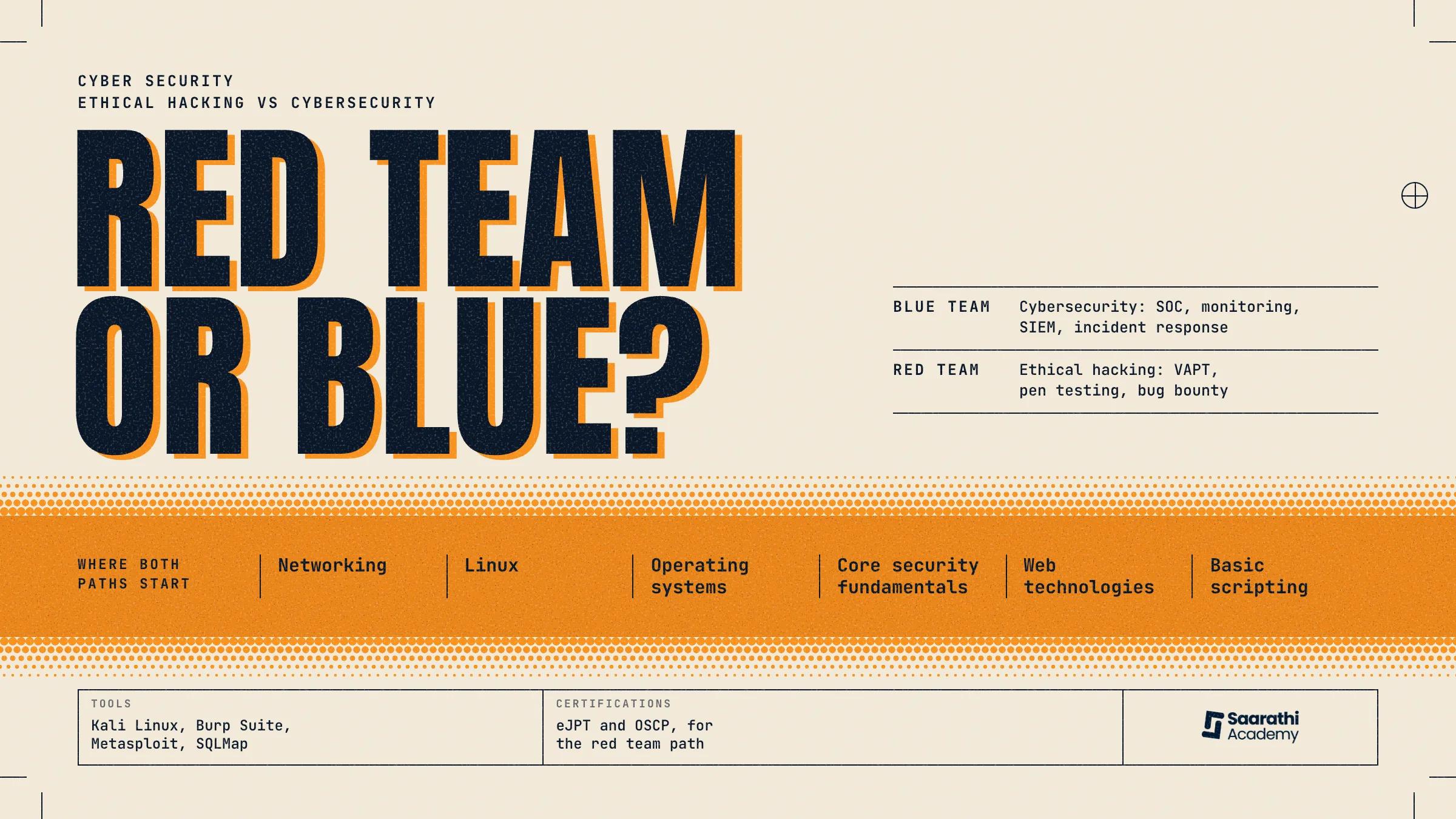
Defensive security: SOC, monitoring, risk, and compliance
People often call this the blue team. A SOC analyst watches logs and alerts all day, notices behaviour that looks wrong, and passes real threats up the chain before they become breaches. The work is full of detail, and it suits people who are patient and good at spotting patterns.
Risk management and compliance are close neighbours. Somebody has to decide which systems to protect first, and somebody has to check that the company really does follow data protection rules. To see how the industry formally groups these defensive jobs, the NIST NICE Cybersecurity Workforce Framework is a handy reference.
What is ethical hacking training?
In ethical hacking you test systems the way a real attacker would, except you have permission and an agreed scope. You're trying to find the weak point before someone with bad intentions gets there.
Most of this work is called VAPT, which stands for Vulnerability Assessment and Penetration Testing. It's mostly offensive security, and it tends to draw people who like solving puzzles with a clock running.
If this direction excites you, look at our VAPT-first program in Kathmandu before you compare course outlines at other places, because institutes don't all organise this training the same way.
Offensive security: VAPT, penetration testing, and bug bounty
After the basics, offensive security spreads into quite a few skills:
Vulnerability assessment
Penetration testing
Web application security
API security
Bug bounty hunting
You also get practical time with tools like Kali Linux, Burp Suite, Metasploit and SQLMap. In a proper lab, Burp Suite lets you catch and change web traffic, SQLMap checks for injection flaws, and Metasploit shows you how an exploit works against a vulnerable machine. For web application security, OWASP is still one of the references people rely on most, particularly its Top 10 list of common vulnerabilities.
Where do cybersecurity and ethical hacking overlap?
Many beginners don't realise that both paths share the same starting point. Before anyone specialises, they have to understand:
Networking
Operating systems
Core security fundamentals
Web technologies
Basic scripting
Learners who skip these basics usually struggle later, whether they end up in SOC work or in penetration testing. For that reason Saarathi Academy builds Phase 1 of its training around networking, recon and host basics, and only then moves to offensive tools. The syllabus shows exactly how this foundation phase is laid out if you want the details.
Ethical hacking vs. cybersecurity: what's the difference?
Putting them next to each other makes the difference easier to remember:
Ethical Hacking | Cybersecurity |
Mostly offensive security | Includes both offensive and defensive security |
Finds weaknesses and exploits them | Keeps systems, networks and data safe |
Penetration testing and VAPT | SOC, monitoring, risk and compliance |
Focused on red team work | Usually blue team or a mix of both |
Bug bounty and security testing | Detecting threats and responding to incidents |
One path isn't better than the other by default. It comes down to whether you like defending and investigating, or taking things apart to find where they break. At this point, the cybersecurity training institute in Kathmandu you pick matters more than whatever name appears on the certificate.
Which path should you choose in Kathmandu?
Don't spend too long on certifications and job titles at the start. Think instead about which kind of everyday work would hold your interest.

Choose cybersecurity / blue team if you want to:
Watch security alerts and look into threats
Work inside a SOC
Learn SIEM and other monitoring tools
Concentrate on defence, risk and incident response
Get a wide grounding in cybersecurity before you specialise
If that sounds like you, read up on the outlook for SOC analyst careers in Nepal before you sign up for a training schedule.
Choose ethical hacking / red team if you want to:
Find weaknesses in websites, apps, APIs and networks
Carry out penetration tests and VAPT engagements
Get practical with offensive security tools
Try bug bounty programs
Work through a structured set of penetration-testing certifications
On this route, look at the certifications that back it up, especially eJPT and OSCP, because they line up well with what employers check for.
Why modern cybersecurity courses teach both
You don't always need to choose one lane on your first day. Many good programs now teach a mix of both, since knowing attack and defence makes you better at each. Defenders who know how attackers think catch threats sooner. Attackers who understand defensive logging know what traces they leave behind.
The Saarathi Academy cybersecurity and ethical hacking program uses this mixed approach over four phases. They are security mindset and networking foundations, then host review and web VAPT, then API VAPT and the exploitation toolchain, and finally SOC work, reporting and career preparation. It shows what a balanced cybersecurity training institute in Kathmandu can look like when the course is built around tasks people do at work, with theory in support.
Career and salary differences in Nepal
With the basics in place, you can aim for a range of jobs on both sides:
SOC Analyst
Security Analyst
Penetration Tester
Cybersecurity Engineer
Security Consultant
What you earn depends on your skills, practical experience, certifications and employer. Whether your course was called cybersecurity or ethical hacking makes little difference. In Nepal, banks, fintech firms, ISPs and systems tied to government need more and more people who can plan an assessment, run it safely and write a report that others can act on. Before you set your expectations, look at a full breakdown of careers and pay for security roles in Nepal.
Final thoughts: which path is right for you?
Cybersecurity is about protection. Ethical hacking attacks systems legally so the gaps are found early.
Neither one wins outright. It depends on whether defending systems or pulling them apart interests you more.
Whichever you choose, the basics decide how far you get. Networking, Linux and real practice count for more than any certificate.
If you live in Kathmandu and want to begin, the 12-week Cybersecurity & Ethical Hacking course at Saarathi Academy takes you from the basics all the way to writing a real penetration test report. Read the syllabus and see whether it matches your plans.