

Cybersecurity certifications in Nepal: a Security+, eJPT, OSCP roadmap that works
Look up cybersecurity certifications in Nepal and the same names keep coming up: Security+, CEH, eJPT, OSCP and CISSP. If you're new, it's hard to know which comes first or which one fits the career you want.
You don't need all of them. You need the right one at each stage, plus real practical skill built up as you go.
Security work is a growing career in Nepal. Banks, fintech firms, telecom operators, other businesses and government platforms all need people who can protect their systems, find weak spots and deal with attacks.
This guide looks at Security+, eJPT and OSCP: what each one tests, who it's for, and where it sits in a practical career plan. Keep in mind that a certificate on its own won't get you hired. Hands-on skill, real projects and practical experience count as well.
Want practical cybersecurity skills? Take a look at our Cybersecurity Course in Nepal.
Why cybersecurity certifications matter in Nepal
They give you a map when everything else feels random
Security covers a huge amount of ground. Without some structure, you can spend a year hopping from one free tutorial to another and never get good at any one thing. A certification gives you a fixed syllabus and a fair sense of the job it leads to. That's why cybersecurity certifications in Nepal are where so many fresh graduates and career changers begin. "I want to work in security" becomes a plan with checkpoints.
A certificate alone won't cut it
Passing an exam is all a certification shows. It tells an employer nothing about whether you can agree a scope, chase a real bug to the end, or write up findings in a form a client can use. Employers hiring for security in Nepal have got better at telling apart people who memorised exam objectives from people who can actually break into a web app. So a sensible certification plan in Nepal always comes with lab practice next to it, and never in place of it.
What employers are actually screening for
Without the jargon, a hiring manager wants to know a few things. Do you stay inside scope and work ethically? Can you find a real issue and prove it? Can you explain it both to an engineer and to a worried manager who isn't technical? The certificate answers the first question. Practice answers the rest.
CompTIA Security+: your entry point
Security+ is the usual first certificate, and it isn't tied to any one vendor. It covers networking basics explained simply, common threats, the basics of cryptography, identity management and day-to-day security operations. There's no practical section and no real exploitation. Think of it as a wide view of the whole field rather than a close look at one part.
For people who are completely new to IT or security, Security+ in Nepal is almost always the first step, and that makes sense. It also suits people already working in networking or IT support who want to move into security without starting from zero. By the end, least privilege, the CIA triad and man-in-the-middle attacks are tools you understand instead of words you've heard, and every later certificate becomes easier because of it.
eJPT: where theory turns into action
eJPT (eLearnSecurity Junior Penetration Tester, now run by INE) is where you start doing the work. There are no multiple-choice questions. You're dropped into a live network and expected to find and exploit vulnerabilities on your own.
eJPT candidates in Nepal go through network and host enumeration, simple web application testing, exploitation with Nmap and Metasploit, and some light post-exploitation. Short of real client work, it is about as close to a VAPT engagement as you can get, which is why it's useful.
It's meant for people who have a Security+ level base and want to show they can apply it. If you've been practising on TryHackMe or Hack The Box and want a credential that matches what you can do, this is a good fit. Put simply, Security+ checks what you know and eJPT checks what you can do. A practical certificate like this gets noticed on a CV.
OSCP: the one that separates serious testers from hobbyists
The Offensive Security Certified Professional exam is hard on purpose. Over 24 hours you break into several live machines and then write a professional report on what you found. There's no multiple choice, and knowing the theory earns you nothing on its own.
The technical depth is only part of the difficulty. The rest is mental: careful enumeration, staying patient when the obvious route fails, and sticking with a problem instead of guessing. Many good testers fail on the first try. That's normal for OSCP and says nothing bad about them.
Before you book it, you should be at ease with Linux and some scripting. You should also know the common web vulnerabilities and be able to exploit them by hand, without leaning on automated scanners. Starting OSCP prep in Nepal without that base is the most common way people waste both money and confidence on a failed attempt. You're ready when you can solve intermediate boxes with very few hints and you've done some real assessment work.
The roadmap: Security+, then eJPT, then OSCP
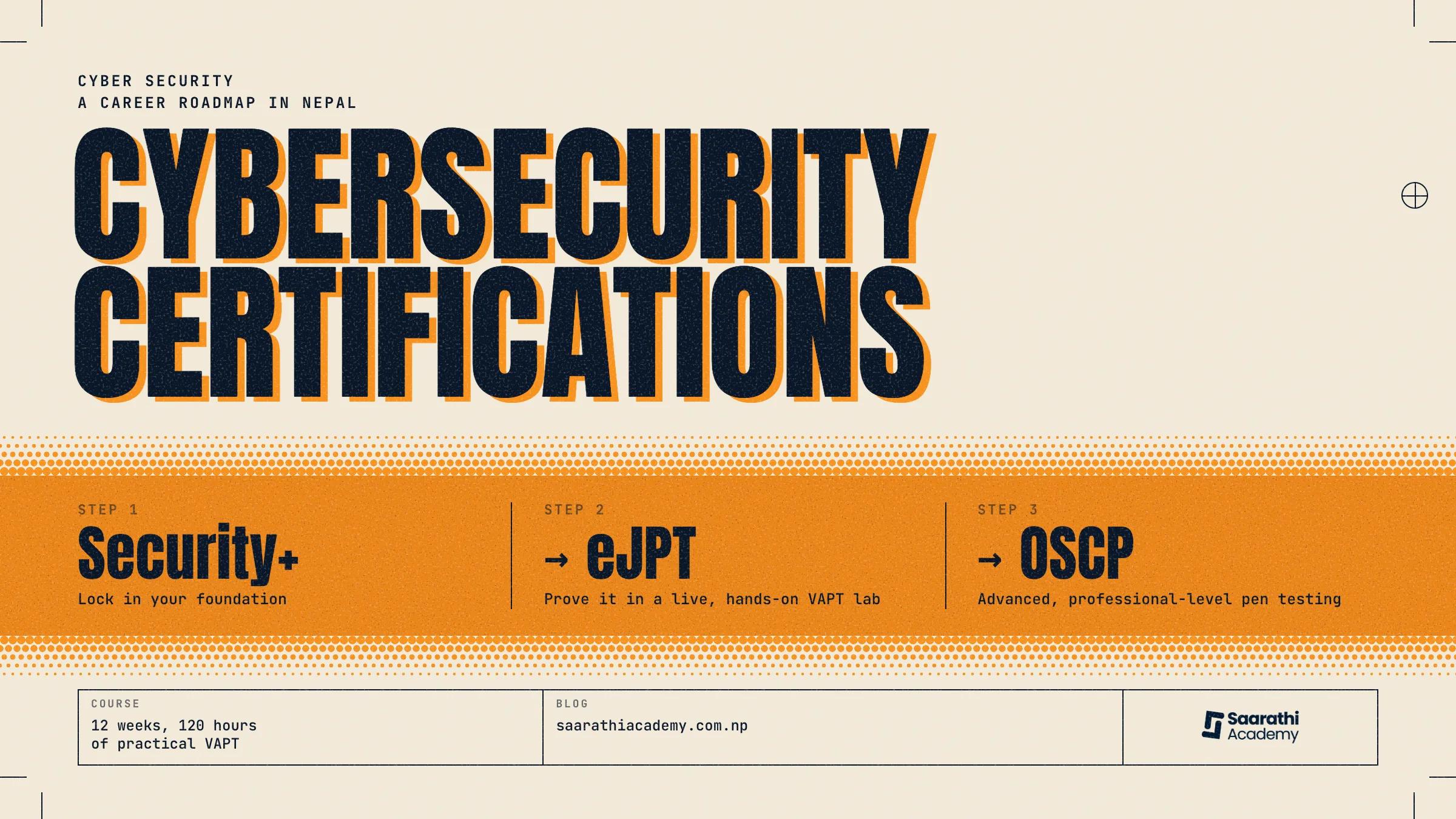
For a beginner, this is the cybersecurity roadmap in Nepal that makes sense:
Step 1, Security+: get solid on networking, threats and the main security ideas.
Step 2, eJPT: show that base holds up in a live, hands-on VAPT setting.
Step 3, OSCP: move on to advanced penetration testing at a professional level.
So where does CEH actually fit?
CEH gets mentioned alongside these three all the time, so it needs a direct answer. The current syllabus at Saarathi Academy sets out the longer path as Security+, then CEH, then eJPT, then OSCP. There, CEH is an optional middle step that adds more theory and tool practice between the basics and the hands-on eJPT. Whether you need it depends on how much of the theory you already know.
Build these skills before you book any exam
Every certificate is easier once these come naturally:
Networking fundamentals: IP addresses, ports, protocols, and how traffic really travels.
Linux basics: the command line, file permissions and routine system admin.
Web security concepts: how requests, sessions and logins really work.
Practice labs: TryHackMe, Hack The Box or PortSwigger Labs.
Core tools: Kali Linux, Nmap, Wireshark, Burp Suite, Metasploit and SQLMap.
Cybersecurity training in Kathmandu: what good actually looks like
Reading about SQL injection is one thing. Finding one yourself in a deliberately weak app at 11 pm, when all you want is sleep, is something else. Good training gets you across that gap faster, and it feels like learning a skill instead of sitting through a course just to earn a certificate.
Good cybersecurity training in Kathmandu gives you live labs, realistic VAPT practice, web and API security testing, live sessions on the same tools used at work, time to practise writing up vulnerabilities, portfolio projects and regular feedback from a mentor. Slides read aloud don't count.
Saarathi Academy's course runs for 12 weeks and 120 hours of practical VAPT work using Kali Linux, Metasploit, Nmap and SQLMap, with separate modules for web security and API security. It finishes with a capstone project, a certification exam and a mock interview. It follows the same order as above (Security+, eJPT, OSCP) and aims at the same roles, Junior Penetration Tester or Security Analyst. The cybersecurity course in Nepal page has the full outline.
Certification vs practical skill: what actually gets you hired
A certificate shows you're committed and that you understand the basics. Practical experience shows you can deliver under real pressure, not only remember answers in an exam hall. Two candidates can show an identical ethical hacking certification in Nepal and still be very far apart in how ready they are for the job. The difference is how much hands-on work went on behind the certificate.
Start collecting proof of your work now: a sample VAPT report, two or so write-ups of web and API tests, a vulnerability assessment project, maybe a small attempt at bug bounty, and tidy notes from your own lab sessions. A structured course helps with this. Saarathi's course, for example, includes proof of work checked by a trainer, a capstone and interview preparation, so students finish with more to show than a certificate.
Which certification should you actually chase first?
Completely new to cybersecurity? Begin with Security+.
Ready for hands-on work? Aim for eJPT next.
Have real hands-on experience already? Move to a penetration testing certification in Nepal such as OSCP.
Not sure at all? Give a few months to fundamentals and labs before you pay any exam fee.
Taking them in the right order does more than anything else to decide whether cybersecurity certifications in Nepal lead to a job offer or just sit on your CV.
The bigger career path in Nepal
Learn the fundamentals, get plenty of VAPT-style practice, build a portfolio you're happy to show, and then apply for junior jobs such as Junior Web/API VAPT Analyst, Tier-1 SOC Analyst or Security Analyst. Moving from there into full penetration testing usually takes two to four years. With more experience, application security and senior security engineering open up later.
Stop collecting certifications, start following the path
Chasing every badge isn't the goal. With cybersecurity certifications in Nepal, what you need is a single clear path that you follow properly.
Security+ gives you the base, eJPT shows you can use it, and OSCP takes you into advanced work. It looks simple, and it works because each step prepares you for the next one, so you aren't left filling gaps later.
If you want to build that base with real labs, feedback from mentors and a portfolio you can show, the Saarathi Academy Cybersecurity & Ethical Hacking Course in Kathmandu follows exactly this path. Have a look before you pick your first certification.