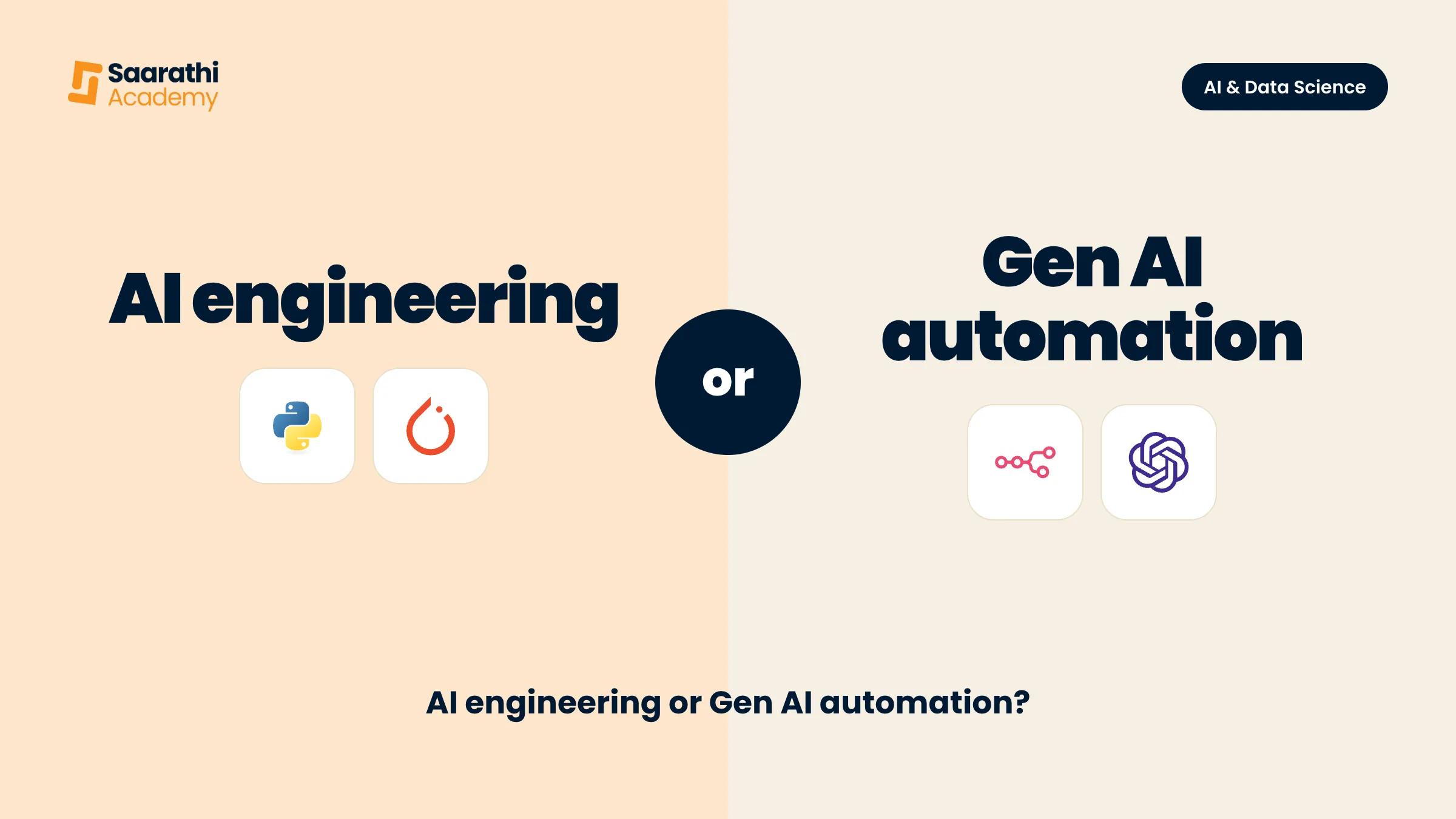
We run two courses with AI in the name, and it is easy to mix them up. The short answer: AI Engineering and Machine Learning is for people who want to build AI systems in code. Generative AI and Automation is for people who want to use AI tools well in their work and automate tasks without writing code. The rest of this post explains the difference so you can match it to your own plan.
The two courses side by side
| AI Engineering and Machine Learning | Generative AI and Automation | |
|---|---|---|
| Length | 12 weeks | 5 weeks |
| Coding | Yes. Python is taught from zero in the first two weeks. | No coding at all |
| Who it suits | Students and career changers aiming at technical AI work | Students, teachers, office workers, shop owners, parents and anyone curious |
| Main tools | Python, pandas, scikit-learn, SQL, LLM APIs, RAG and agents | ChatGPT, Claude, Gemini, Perplexity, Zapier, Make and n8n |
| What you finish with | A deployed AI system as your capstone | Your own working automation for a small business, priced and demoed |
The facts in this table come from the two course pages. If a course page and this post ever disagree, the course page is right.
What AI Engineering teaches
AI Engineering starts with Python basics, because most people who join have never coded. From there it moves to working with data in pandas, writing SQL queries, and training classical machine learning models such as linear regression, decision trees and random forests, with honest testing of how good they really are. The second half covers how large language models work, calling them from code, retrieval (RAG, where the model answers from your own documents), agents and fine-tuning. The course ends with a capstone you deploy, and you learn to track what it costs to run.
This is a building course. You will spend most of your time writing and fixing code. That is the point of it.
What Generative AI and Automation teaches
Generative AI and Automation is slow-paced on purpose. The first weeks cover ChatGPT, Claude and Gemini for daily work, how to write clear prompts, AI search with Perplexity, and making images and short videos with AI tools. You also build your own Gemini Gem, a custom assistant set up for one job.
Two weeks go to no-code automation with Zapier, Make and n8n. You build a workflow for a small business in Nepal, for example answering common customer questions or sorting orders, and you keep a step where a person checks the work before anything goes out. The last week covers running a supervised AI agent, then pricing and showing your own workflow.
How to choose
Pick AI Engineering if you want a technical role where you build AI features, you are ready for 12 weeks of steady coding practice, and you enjoy figuring out why something broke.
Pick Generative AI and Automation if you want to save hours in the job or business you already have, you do not want to code, or you want a short first step to see how far AI tools can take you.
You can also take both, in that order. The no-code course shows what AI can and cannot do in real work, which helps you decide whether you want to build it yourself. Going the other way makes less sense, because AI Engineering already covers the tools in more depth.
A few common mix-ups
"Generative AI" does not mean the easier course. Both courses use generative AI. The difference is whether you use it through tools or build with it in code.
Automation is not the same as AI engineering. Connecting apps in Zapier or n8n so that a form entry becomes a WhatsApp reply is automation. Training a model or building a retrieval system is engineering. Both are useful, but they need different skills.
You do not need maths to start either course. AI Engineering teaches what you need as it goes. The no-code course needs none.
Still not sure?
Look at the week-by-week syllabus on each course page, or visit us in Old Baneshwor and ask. Both courses run in small batches in the classroom, with online seats too.