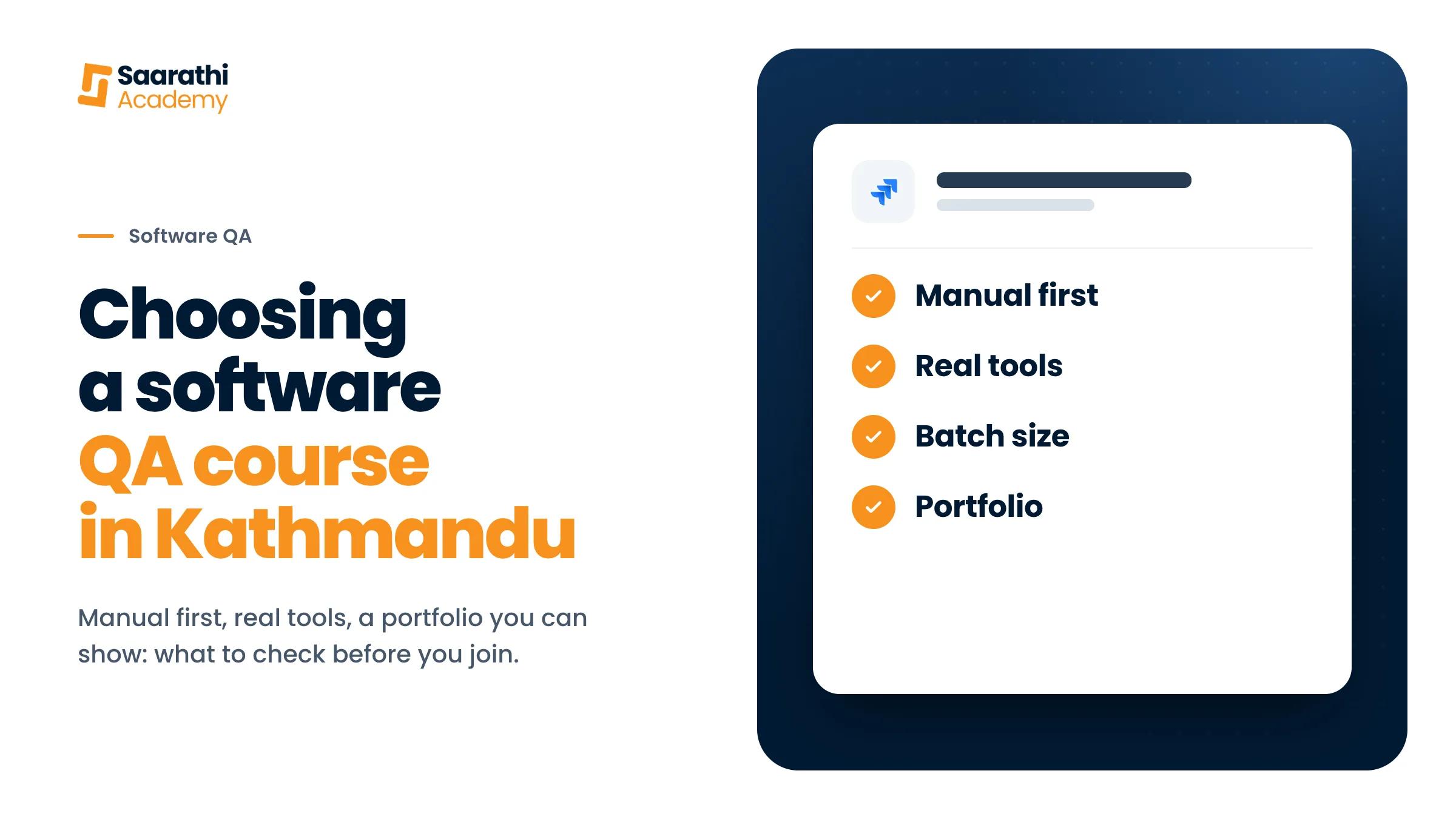
To choose a software QA course in Kathmandu, check six things before you pay. Read the syllabus week by week and make sure manual testing comes first, then automation. Check that you use the real tools hands-on, not only see them on slides. Ask how many students sit in one batch, and who teaches. Find out what you will have in your portfolio at the end. Check that the course starts from your level, especially if you have never written code. And ask what the career support includes, in plain words. If a course answers all six clearly, take a closer look. If it dodges two or three of them, keep looking.
We go through each check below, and they work for any QA training in Nepal you are looking at. At the end we put our own course through the same list.
What a QA tester does day to day
QA stands for quality assurance. A QA tester checks that software does what it should before real users touch it, and finds the places where it breaks. Before you pick a course, it helps to know what the job looks like on a normal day.
- Reading a new feature's requirements and asking questions before any code is written. What should happen if the user enters a wrong OTP three times? What if the network drops halfway through a payment?
- Writing test cases: the steps, the input and the result you expect.
- Running those tests on the app, on different browsers and phones.
- Filing bug reports in a tool like Jira, with clear steps so a developer can see the bug for themselves.
- Testing the fix, then running regression tests to make sure the fix didn't break something else.
- Joining the team's standups and sprint meetings, and saying clearly whether a release is safe to ship.
- In teams with automation, writing and maintaining test scripts that run every time someone changes the code.
A good course teaches all of this as work you actually do, not as definitions to memorise. If you are still deciding whether this job suits you at all, read is software QA a good career in Nepal first.
Manual testing first, then automation
Some courses teach only manual testing. Others jump straight into Selenium scripts in week one. Neither order works well for a beginner.
Automation only runs the checks you tell it to run. If you can't decide what to test, a script just repeats a weak test faster. So the foundations come first: how software gets built and where testing fits, how to design test cases, how to write a bug report, and how testers work in an Agile team. Then the course should add API testing, which is quicker to learn than browser automation and is asked about in many interviews. Browser automation comes after that, once you know what is worth automating.
Look for this order in the syllabus:
- Testing basics: the SDLC (software development life cycle), the STLC (software testing life cycle), and the main types of testing.
- Test design: techniques like equivalence partitioning and boundary value analysis, plus exploratory testing.
- Bugs and teamwork: the bug lifecycle, Jira, and how a tester works inside Scrum.
- API and database testing: Postman and enough SQL to check what got saved.
- Automation: a programming language, then a framework like Playwright or Selenium, then running tests automatically on every code change.
If a course spends only a week on manual testing, or leaves automation out completely, ask why. For a longer look at this question, read manual testing or automation testing: where should a beginner start.
Tools a QA course should teach hands-on
Every course lists tools. What matters is whether you use each one on a real app, with a mentor checking your work. Here is what to look for in QA automation training, and why each tool is there.
- Jira. Most software teams track bugs and tasks here. You should file real bugs, move them through their lifecycle and link them to test cases.
- A test management tool. TestRail, Zephyr or Qase hold your test cases and record each test run. Many teams still keep test cases in Excel sheets, so it helps to know that format too.
- Postman. The common tool for testing APIs by hand. You build collections of requests and check the responses. Newman runs those collections from the command line, so they can run automatically.
- SQL. Testers often need to check that the right data reached the database. You don't need to be a database expert, but you should write simple queries with confidence.
- Playwright or Selenium. These drive a real browser and check that pages work. Selenium WebDriver has been around for many years and still appears in a lot of job posts. Playwright is newer, from Microsoft, and runs the same tests on Chromium, Firefox and WebKit. A course should teach at least one of them properly, with the Page Object Model, a common way to keep test code tidy as it grows.
- A programming language. Automation means writing code. TypeScript, JavaScript, Java and Python are all common in test code. The course should teach the basics before the first test script, not assume you already know them.
- Git and GitHub. Your test code lives here, and employers will look at it.
- CI (continuous integration). Tools like GitHub Actions or Jenkins run your tests every time code changes. A course should show you a pipeline that fails when a test fails.
- A performance testing tool. k6 or Apache JMeter, enough to run a basic load test and read the results.
Ask the institute to show you a student project that uses these tools. A list on a brochure tells you very little. A working test suite on GitHub tells you a lot.
Course length, schedule and batch size
Compare total guided hours, not only weeks. Ten weeks of one class a week is much less than eight weeks of daily classes. Ask how much practice at home is expected too. Testing is a skill you build by doing it, so plan for practice time on top of class.
Batch size decides how much feedback you get. In a QA course, feedback means someone reads your test cases and bug reports and tells you what is missing. That is hard to do well for a big room. Ask for the maximum number of students in one batch, not the average.
If you want to join online, ask whether online students get live classes and the same review of their work as the classroom. Recorded videos are easier to start, but nobody checks your test cases.
What your portfolio should show by the end
A certificate says you finished a course. A portfolio shows what you can do. When a hiring manager in Kathmandu looks at a junior QA applicant, they want proof they can open and check in a few minutes.
By the end of a good course, you should have most of these:
- A test plan for a real app, with what you will test, what you won't, and why.
- A set of well-written test cases that cover normal use, edge cases and errors.
- A Jira project with bug reports a developer could act on without asking you questions.
- A Postman collection that tests a real API, with checks on the responses.
- An automation project on GitHub, using Playwright or Selenium, with clean structure and a CI pipeline that runs the tests.
- A short write-up of one project: what you tested, the bugs you found and what you would test next.
Push for specific answers when you ask about projects. Will you test a real app, or only toy pages? Does everyone build the same copy, or do you choose a project with your mentor? Does a mentor review the test code, or only check that it runs?
What about ISTQB?
ISTQB (International Software Testing Qualifications Board) runs the most widely recognised certification for software testers. Its entry level is the Certified Tester Foundation Level, often called CTFL. You don't need work experience to sit it. The exam is multiple choice and covers testing theory and vocabulary, and you book it through an ISTQB member board or an approved exam provider, not through a training course.
CTFL can help, especially at companies that test software for clients abroad. But it tests theory, not whether you can write a good bug report or an automation script. If a course says it is "ISTQB certified", ask exactly what that means. Is the institute an accredited training provider? Is the exam fee included? Or does the course just follow the same topics? All three can be fine, as long as you know which one you are paying for.
Questions to ask before you join
Take this list when you visit or call an institute, and write down each answer.
- Can I see the full syllabus, week by week?
- How many weeks are manual testing, and when does automation start?
- Which tools will I use hands-on, and on what kind of app?
- Do I need to know programming before I join? If not, where is the language taught?
- What is the maximum number of students in one batch?
- Who teaches, and have they worked as testers?
- How many guided hours are there, and how much practice at home is expected?
- Is there an online option with the same feedback as the classroom?
- What will be in my portfolio at the end, and will it be on my own GitHub?
- How am I assessed at the end?
- What exactly does the career support include, and do you promise a job?
The right answer to the last question is no. No institute decides who gets hired. A course can control what you learn, what you build and how ready you are for interviews. Good job help means a CV review, a mock interview and honest feedback, written down before you pay.
For judging training centres in general, not only QA ones, see our guide on how to choose an IT training center in Nepal.
How Saarathi Academy measures against the checklist
Here is how our own Software Quality Assurance course in Kathmandu answers each point, going by what the course page states.
- The course runs 8 weeks and the syllabus is listed week by week. Weeks 1 to 3 are manual testing: the QA role, SDLC and STLC, test design, the bug lifecycle in Jira, Agile QA, and a full test run in a test management tool (TestRail, Zephyr or Qase). Week 4 is API testing with Postman and SQL, plus security checks from a tester's side. Weeks 5 to 7 are automation with Playwright and TypeScript, the Page Object Model, cross-browser tests, CI with GitHub Actions, and load tests with k6 and JMeter. You also rebuild the core flows in Selenium WebDriver as a second project. Week 8 is your capstone demo, portfolio and job applications.
- Classes run Monday to Friday, 2 hours a day, about 80 guided hours in total. Plan on at least two more hours of practice at home on every class day. On Sundays the classroom is open from 11 AM to 4 PM for students to study and build together.
- A batch has 10 seats in the room in Old Baneshwor, plus up to 5 online seats.
- No prior programming is needed. TypeScript is taught from zero in Week 5. A short starting check before Day 1, with no pass or fail, shows the mentor where you stand.
- You hand in a QA portfolio on GitHub: a test plan, test cases, a Jira bug history, a test run report, a Postman collection, SQL checks, a Playwright framework running in CI and a Selenium framework.
- You are assessed with a proctored certification exam plus a capstone project review, and you get the certificate of completion when you pass both.
- We are not an ISTQB exam centre and we don't sell the exam. The weekly QA fundamentals follow the CTFL syllabus topics, so the same study helps if you decide to sit it.
- Career support covers a CV and LinkedIn review and a 1:1 mock interview. We do not guarantee placements.
The full week-by-week plan, the fee and the syllabus PDF are on the software QA course page. Whichever course you choose, take the same checklist with you. The right one answers every question clearly.