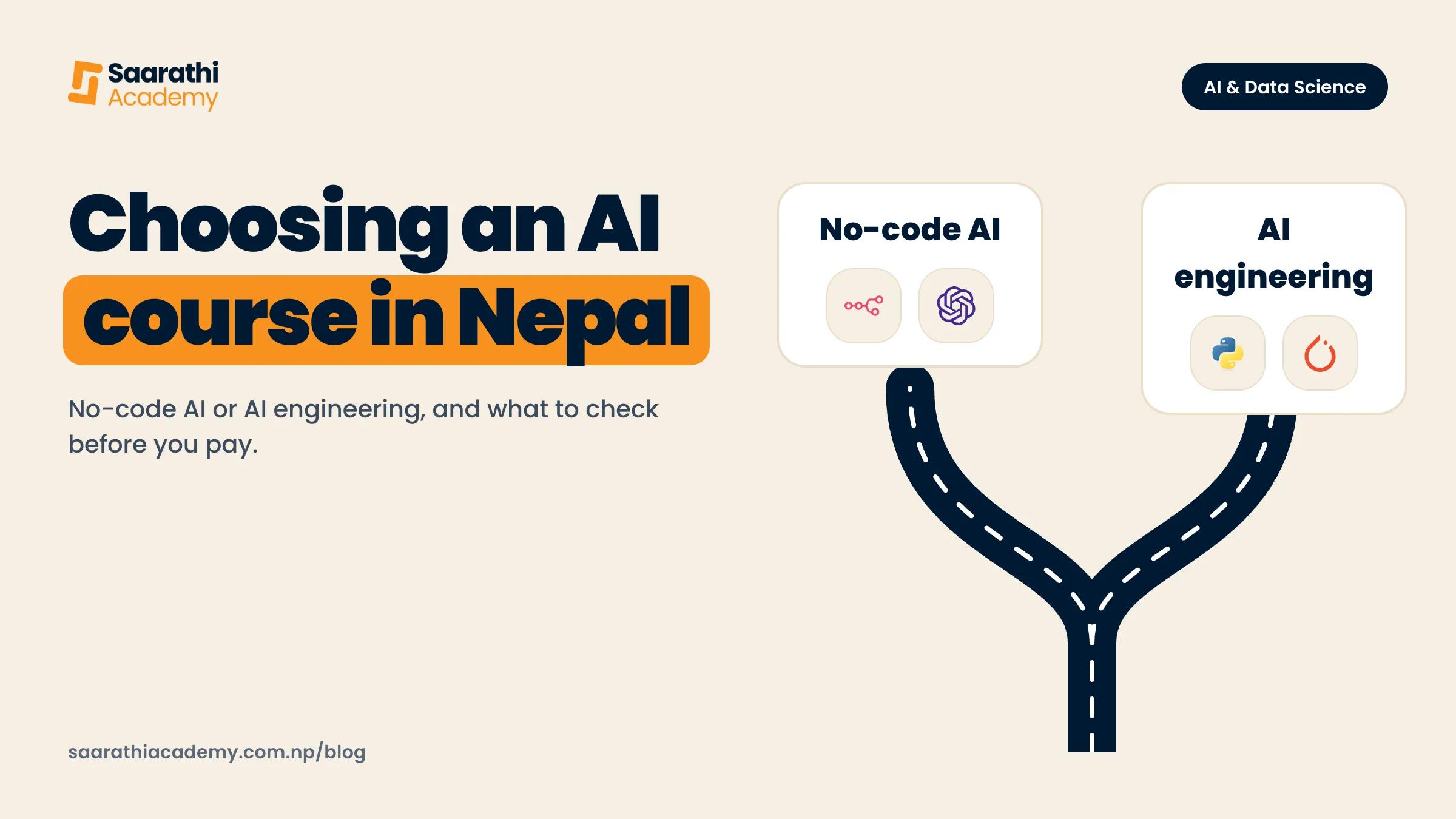
To choose an AI course in Nepal, first decide which kind you need. A no-code course teaches you to use AI tools. An AI engineering course teaches you to build AI apps with Python. Then check the syllabus week by week, count the live hours, ask who teaches, and ask to see a working student project and a free class.
This guide gives you a fair checklist you can use on any institute in Kathmandu or online. At the end we show how our own courses answer it, so you can judge us by the same rules.
What kinds of AI course are there?
"AI course" can mean three different things, and they lead to different jobs. Before comparing institutes, decide which one you want. Comparing a no-code course with an engineering course by fee alone will mislead you.
| Type | What you learn | Who it suits |
|---|---|---|
| No-code AI and automation | Using ChatGPT, Claude and Gemini well, building automations in tools like Make.com or Zapier | Students, office workers, freelancers and business owners who do not want to code |
| Machine learning and data science | Python, statistics and models that predict from data | People aiming for data analyst or data scientist roles |
| AI engineering | Python, machine learning, deep learning, LLM apps, RAG, agents and deployment | People who want to build and ship AI software |
What should an AI engineering course cover?
A good AI engineering course starts with Python and machine learning basics, then moves to LLMs, RAG, agents, testing and putting an app online. An LLM is a large language model such as the one behind ChatGPT. RAG means letting the AI answer from your own documents. The finished project should run online, not only in a notebook.
| Area | What to look for | Why it matters |
|---|---|---|
| Python | Real time on the language before any AI library | Without it, every error message is a wall |
| Classical machine learning | Metrics, cross-validation, data leakage, tree models | Teaches you to test a model honestly, which you need later for LLM apps |
| Deep learning | Neural networks and how transformers work, with PyTorch | Explains what is inside the models you call |
| LLM APIs and prompting | More than one provider, structured outputs, cost control | Most AI jobs today build on these APIs |
| Embeddings and RAG | Vector databases, retrieval, reranking, measured answer quality | Answering from company documents is a common task in AI engineering jobs |
| Agents | Tool use, orchestration, and limits on what an agent may do | Agents are useful but break in new ways, so control matters |
| Evaluation and safety | Testing answers, prompt injection, the OWASP LLM Top 10 | An AI app that nobody tested is a risk to the company |
| Deployment | An API, a container, tracing and a cost record | A live app is what separates an engineer from a tutorial |
Be careful with an "AI course" that is mostly prompt tips, or one that promises you will "build ChatGPT" in a few weeks. Ask what your final project will be and where it will run.
How long should an AI course be?
Count total live hours, not months. An AI engineering course needs time for Python, machine learning and building, so very short courses usually skip the basics. A no-code course can be shorter because there is no programming.
How do I calculate total live hours?
Multiply classes per week by hours per class by number of weeks. Recorded videos do not count.
| Example format | Classes per week | Hours per class | Weeks | Total live hours |
|---|---|---|---|---|
| Example A | 5 | 2 | 12 | 120 |
| Example B | 5 | 2 | 5 | 50 |
| Example C | 3 | 1.5 | 12 | 54 |
Divide the fee by the live hours to get a cost per hour with a mentor. Also ask who pays for API usage during the course, since LLM APIs charge per use.
What 5 questions should I ask before joining?
Ask every institute the same five questions. A good answer is something you can check.
1. Who teaches the class?
A good answer names the mentor and says what AI work they do now. AI tools change every few months, so ask whether the mentor builds with them at work today. Ask whether that person will teach your batch.
2. Can I see a working project from a past student?
A good answer is a live link or a GitHub repository you can open. Look for an app that runs, with a short README. If the institute is new, ask to see the project briefs instead.
3. How much feedback will I get, and how big is the batch?
A good answer gives a batch size number and says who reviews your weekly work. AI code fails in ways that are hard to debug alone, so mentor time matters here.
4. What happened to past students?
A good answer is specific, with names you could check on LinkedIn. Be careful with a job guarantee. Ask to see the exact wording in writing.
5. Can I attend a class before I pay?
A good answer is yes, a real class with the current batch, not a demo. One class shows you the pace and whether you can keep up.
How do Saarathi's AI courses answer these?
We run two AI courses in Old Baneshwor, Kathmandu, both online and offline, with at most 10 students in the classroom. These answers come from our published syllabi.
| Course | Length | Live hours | Coding |
|---|---|---|---|
| AI Engineering and Machine Learning (TR-10) | 12 weeks | About 120 | Yes, Python from zero |
| No-Code AI, Agents and Automation (MD-03) | 5 weeks | About 50 | No code at all |
What does the AI Engineering course cover?
It goes from Python to a deployed AI app. Weeks 1 and 2 are Python. Weeks 3 and 4 are data tools and classical machine learning with scikit-learn. Week 5 is deep learning and how transformers work, with PyTorch. Week 6 is prompting and LLM APIs. Weeks 7 and 8 are embeddings, vector databases and a RAG pipeline. Weeks 9 and 10 are tool-using agents, LangGraph, MCP, evaluation and safety, including the OWASP LLM Top 10. Week 11 is fine-tuning with LoRA and running models on your own machine. Week 12 puts your capstone online with FastAPI and Docker, with tracing and a cost record. You use AI coding tools such as Cursor from Week 1.
What does the No-Code AI course cover?
You never write code. You use ChatGPT, Claude, Gemini and Perplexity for writing and study, build your own custom assistant, make AI images and video, and compare Zapier, Make.com and n8n. You then build one real automation in Make.com with a human review step, and put an AI agent to work on one supervised errand. You finish with one real workflow, built and priced.
How many hours, and what is the weekly routine?
Both courses run Monday to Friday, 2 live hours a day. For AI Engineering that is 5 times 2 times 12, which gives 120 live hours. We expect about 2 more hours of self-study at home each day. Sunday is an open classroom you can use or skip.
Who teaches?
Our mentors still work in the field they teach, and each has at least four to five years of professional experience. Ask us who will teach your batch.
What will I build?
In AI Engineering, you finish with a live capstone you can trace and cost. Project briefs include a RAG app over private documents measured with RAGAS, an agent built with LangGraph, a cost-optimised LLM service, and a fine-tuned local model served with FastAPI. Ask to see past capstones when you visit.
How much feedback will I get?
In AI Engineering, all 12 weekly deliverables are handed in and reviewed by a trainer, and in the final week you sit a full mock interview with your mentor. In the No-Code course, a mentor reviews your automation, your custom assistant and your final workflow against a simple rubric, and each project ends with a short live walkthrough. Both courses end with a proctored certification exam of about 30 questions, with a 70 percent pass mark, plus a capstone review.
What about jobs and outcomes?
We do not promise a job or a salary. Your pay depends on your skills and your portfolio. Career support means CV and LinkedIn reviews, a mock interview and referrals into our hiring partner network. Ask us to put you in touch with a current student.
Can I try a class first?
Yes. If you need it, you can sit in on one class for free before you pay. Message or call us to pick a day.
See the full week by week plan on our AI Engineering and Machine Learning course page. If you do not want to code, see the No-Code AI, Agents and Automation course page.