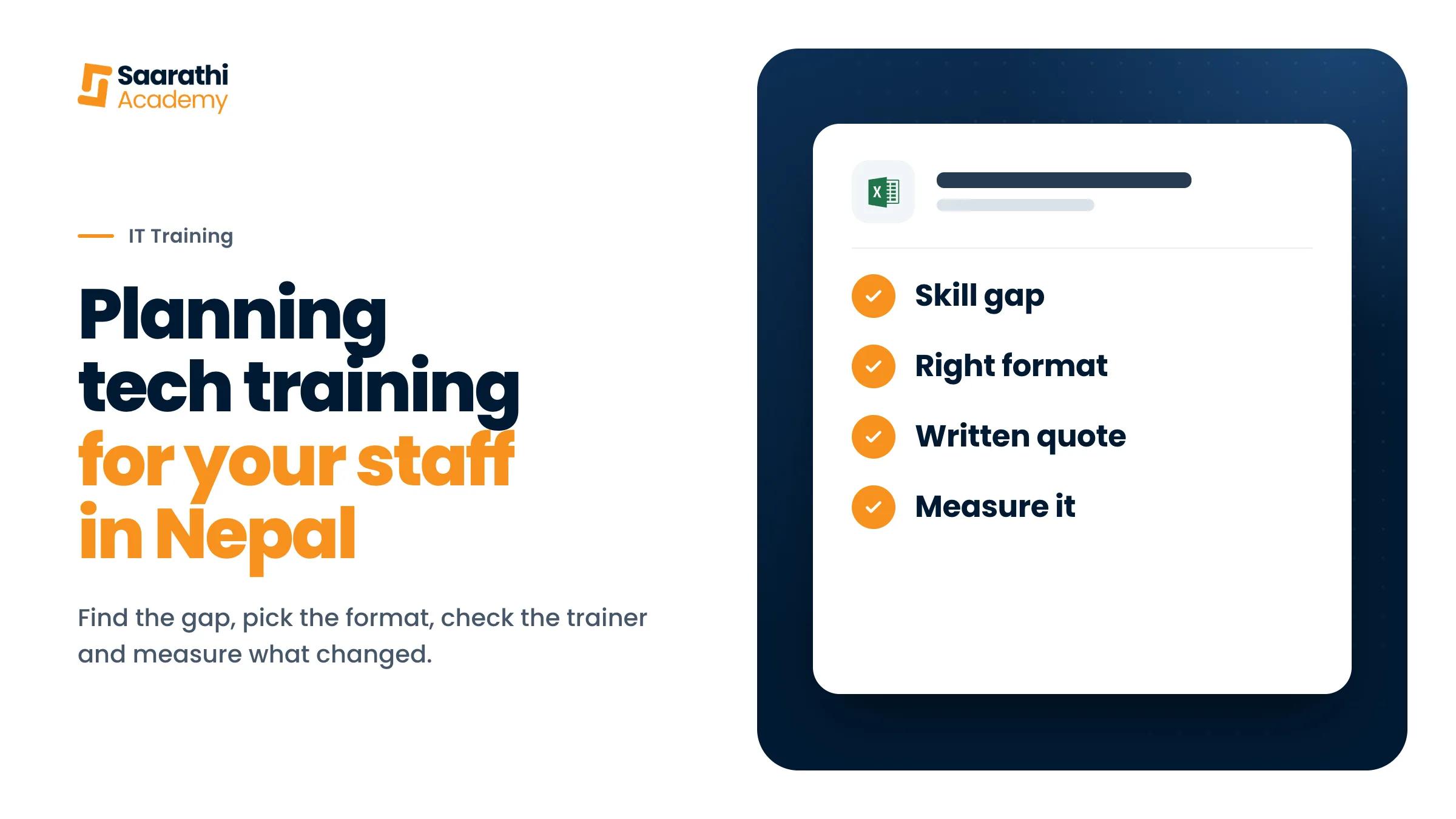
To plan tech training for your staff in Nepal, start with the skill gap, then choose the format. Write down which tasks your team finds hard today and what they should be able to do after the training. Pick a short workshop for one narrow skill and a longer program for a full new role. Decide whether the sessions happen at your office, online or at the trainer's centre, based on who attends and what they need to practise on. Before you sign, ask the training partner for a written syllabus, the names of the trainers and a written quote. After the training, check whether people actually do the work differently.
This guide is for business owners and HR managers paying for the training. Each step below works with any corporate training in Nepal you are comparing.
Find the skill gap first
Training money is easy to waste when nobody writes down what the team should learn. "Our staff should learn AI" is a wish. "Our two accountants should build the monthly sales report in Excel without copying numbers by hand" is a gap you can train for.
To find the gap, talk to three groups of people.
- The managers. Ask which tasks get delayed, sent back or done by one person because nobody else can.
- The staff themselves. Ask what slows them down and where they search YouTube or ask a colleague every week.
- Your customers. Complaints about slow replies, wrong invoices or a broken website often point to a skill problem inside the team.
Then write each gap as one sentence: who, what they can do now, and what they should be able to do after. Keep the list short. Three clear gaps are easier to train for than ten loose ones.
It also helps to check the current level of each person. A short task, like cleaning a messy spreadsheet or finding a bug on a test page, tells you more than a self-rating form. People who are far apart in level can be split into two groups, so the beginners are not lost and the stronger people are not bored.
Workshop, short course or a longer program
The length of the training should match the size of the gap.
- A one or two day workshop fits one narrow skill. Examples are using an AI chat tool safely for office writing, basic Excel formulas and pivot tables, or spotting phishing emails.
- A short course over a few weeks fits a skill that needs practice between sessions, such as writing test cases, running Meta ads or building simple automations. People learn, try it at work, and bring their questions to the next session.
- A longer program fits a new role, like moving a support person into QA testing or training a junior developer in cloud and DevOps work. This takes months, with projects and reviews along the way.
A one day workshop will not turn a beginner into a developer. Be honest about this when you set the budget. Long programs also need a quiet month and managers who really give people the hours off for class.
Onsite, online or at the training centre
Each option has a clear use.
Onsite at your office works well when the whole team attends together and the training uses your own systems, data or software. The trainer sees the real setup. The weak point is interruptions. Staff get pulled out of class for urgent work, so book a separate room and keep phones away during exercises.
Live online suits teams spread across branches or cities, and it saves travel time. It works for tool skills where everyone shares a screen. It is harder for hands-on help, so ask how the trainer checks each person's work during the session, and make sure every attendee has a working laptop and a stable connection.
At the training centre takes people away from their desks, which helps them focus. It also makes sense when the course needs lab machines or software your office does not have.
What a good training partner shows you before you sign
Ask for these things in writing before you pay anything.
- A syllabus built from your gap. It should list topics session by session and say what people will be able to do at the end. A generic brochure is a warning sign.
- Who will teach. Ask for the trainer's name and what work they do outside class. Someone who uses the tools at work every week can answer the odd questions your staff will ask.
- How much practice there is. Ask what share of each session is hands-on exercises, and what your staff will build or do during the course.
- Group size. Ask how many people one trainer handles. In a big group, the quiet staff members rarely get their work checked.
- A written quote. It should state what the price is based on, what is included and what is extra, such as travel, software licences or certificates.
- What you get at the end. A certificate is nice for the staff. As the employer, you also want a report on attendance and on what each person could do by the end.
If you are also comparing institutes for your own staff to join as regular students, our guide on how to choose an IT training center in Nepal covers the same checks for public courses.
How to check the training worked
Decide how you will measure success before the training starts, using the gap sentences you wrote in step one. A common way to think about it is the Kirkpatrick model, which looks at four levels: how people felt about the training, what they learned, whether they changed how they work, and whether the business result changed.
In practice, for a small or mid-sized company in Nepal, that means a few simple checks.
- Right after the course, give each person a short practical task from their real job and see if they can do it alone.
- After 30 days, ask their manager whether they are using the new skill. Look at real work, like the report they built or the automation they set up.
- After 60 to 90 days, look at the number you hoped would move. That could be hours spent on a monthly report, replies sent late, or bugs found after release.
If people learned the skill but do not use it, the cause is often at work. Maybe they have no time, no access to the tool, or a manager who still asks for the old way. Fix that first before paying for more training. For automation skills in particular, a small first project helps. Our post on what you can automate without coding using n8n has examples of first tasks a team can take on after a course.
How Saarathi does corporate training
Saarathi Academy is a tech training institute in Old Baneshwor, Kathmandu. Our corporate and college training starts with a short call or visit to learn what your people need. We then design the course, with weeks, topics and outcomes shared before anything is booked.
Companies can choose a workshop of one to five days, or a single-day format if that is all the team needs. Colleges can book a full semester program with attendance and assessments. The subject can be any of our 10 courses, from AI to cybersecurity, cut down to the parts your team needs. Sessions run at your office or campus, or hybrid. We teach on-site in the Kathmandu valley, and teams elsewhere in Nepal can take the same sessions live online.
The instructors who run our own batches teach the sessions, with exercises and feedback in every session. We agree the group size with you when we plan the course. The price is worked out from the topics, the number of days and the group size, and you get the quote in writing before anything is booked. Everyone who completes the program gets a certificate, and you get a written report on attendance, results and what participants can now do.
If you also want to hire trained people or get a team built for you, see our page for teams. To start, send us the gap sentences from step one and we will tell you what format fits.