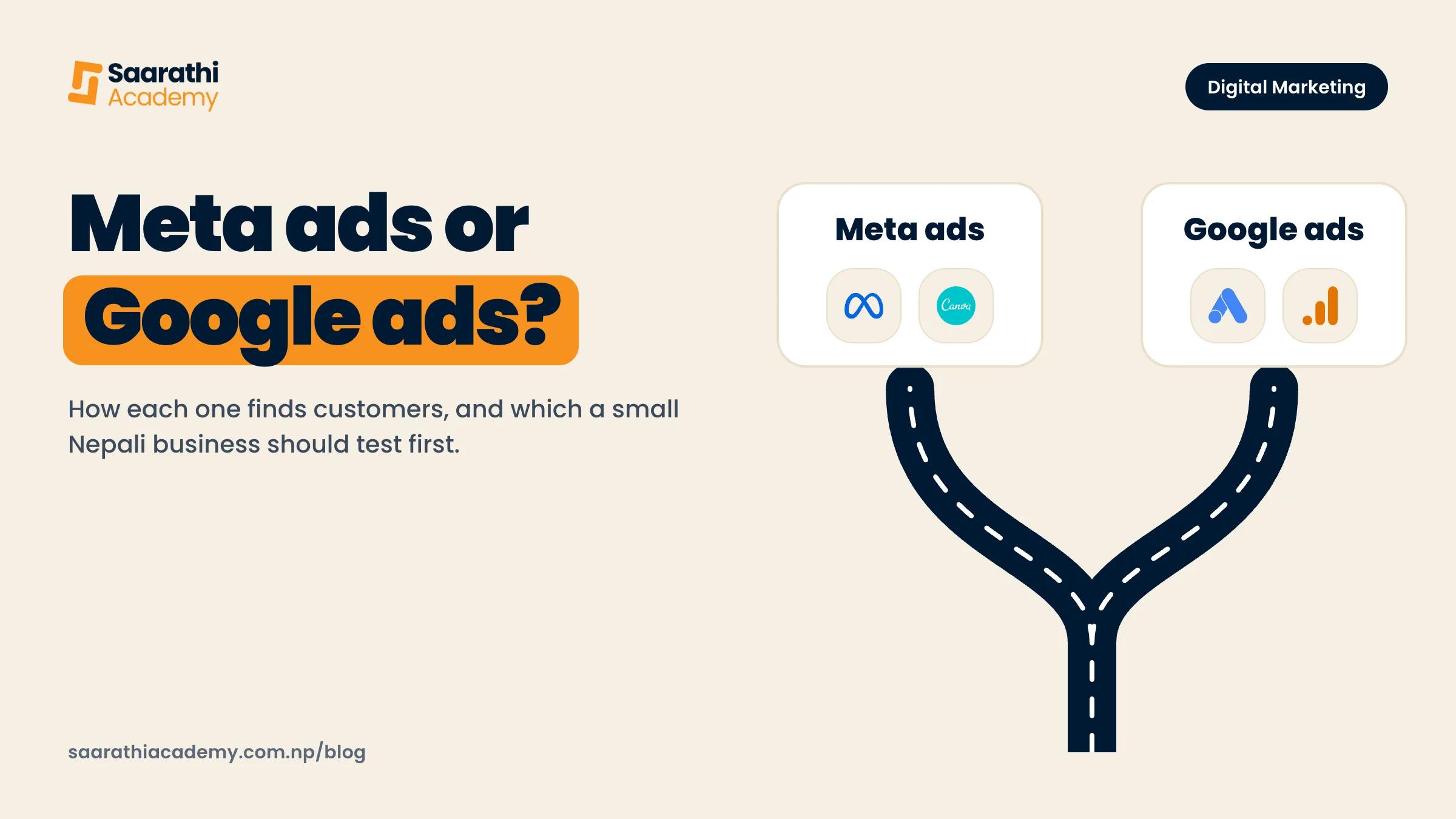
Meta ads show your business to people who are not searching yet, based on their interests and location. Google ads show your business to people who are already searching for what you sell. For most small businesses in Nepal that sell something people discover by seeing it, such as clothes, food or gifts, Meta ads are the easier start. For services people search for when they need them, such as repairs, clinics or tuition, Google ads often fit better.
Many businesses end up using both. The question is which one to learn and test first. This post is part of our guide on how to learn digital marketing step by step.
How each one finds customers
| Meta ads | Google ads | |
|---|---|---|
| Where ads show | Facebook, Instagram, Messenger and WhatsApp | Google search results, plus YouTube and other Google sites |
| How it picks people | Interests, age, location and behaviour | The words a person types into Google |
| Customer's mood | Scrolling, not looking for you yet | Searching, already wants something like yours |
| What you need most | An image or short video that stops the scroll | The right keywords and a clear landing page |
| Common goal | Messages on WhatsApp or Messenger, page visits | Calls, website enquiries, visits to a shop |
Meta ads in plain words
Meta ads work like a shop window on a busy street. People walking past were not looking for you, but a good display makes them stop. Your ad needs a strong hook, the first line or first seconds that catch attention.
In Nepal, many small businesses close sales in chat. Meta lets you run click-to-WhatsApp and click-to-Messenger ads, where the button opens a chat with you. If you sell through conversation, this fits the way you already work. It also means someone must reply to messages quickly, or the ad money is wasted.
Google ads in plain words
Google ads work like a signboard at the exact moment someone asks for directions. A person searching "laptop repair in Baneshwor" has a problem today. If your ad answers it, they are likely to call.
The catch is that some businesses have very few searches. If almost nobody in Nepal types what you sell into Google, there is little for Google ads to show against. Check search interest first with Google Keyword Planner or Google Trends.
Which fits which kind of business
| Type of business | Usually start with | Why |
|---|---|---|
| Clothing, shoes, accessories | Meta | People buy what they see. Photos and short video sell it. |
| Cafe, restaurant, bakery | Meta | Food looks good on Instagram and Facebook, and location targeting keeps it local. |
| Handicrafts, gifts, home products | Meta | Most people do not search for these until they see them. |
| Repair services, plumbers, electricians | People search when something breaks. | |
| Clinics, dentists, physiotherapy | Google, with Google Business Profile | People search for a nearby service they need now. |
| Tuition, courses, training | Both | Some people search, others decide after seeing an ad. |
| Travel and trekking agencies | Both | Visitors search on Google, and photos on Meta spark interest. |
This table is a starting point, not a rule. Your own small test will tell you more than any table.
How to start small
Whichever you pick, start with a small daily budget you can afford to lose while learning. Treat the first weeks as a test, not as a sales plan.
- Set up tracking first. On Meta, install the Meta Pixel on your website. On Google, set up conversion tracking. If you only take orders in chat, count the messages yourself.
- Pick one goal. Messages, calls or form fills. One campaign, one goal.
- Keep the area tight. Target only the places you can serve or deliver to.
- Make a few ads, not one. On Meta, try two or three different hooks. On Google, write ads that repeat the words people search.
- Wait before you judge. Give a test enough days to collect results before changing it. Changing things every day makes it hard to learn anything.
- Look at the right number. Count enquiries and sales, not likes or views. Then work out what each enquiry cost you.
A note on payment
Meta and Google charge in dollars. Most small businesses in Nepal pay with a dollar card or through an agency that bills in rupees. Sort this out before you plan a campaign.
Signs an ad needs changing
Ads do not stay fresh forever. When the same people see the same ad again and again, they stop noticing it. Watch for these signs:
- Fewer people click than in the first week, even though the ad is shown just as much.
- Each enquiry costs noticeably more than it did at the start.
- People comment that they keep seeing the ad.
When two of these show up together, make a new ad with a new idea, not just a new colour. On Google, also read the search terms report. It shows the exact searches that triggered your ad, so you can block the ones that will never buy.
Do not skip the free options
Before paying for ads, make sure the free basics are done. A complete Google Business Profile helps local searches at no cost. An active Facebook or Instagram page gives your ads somewhere to send people. Ads work better when the page they lead to already looks trustworthy.
Learning both properly
Running ads well is a skill: setting goals, tracking results and knowing when an ad has gone stale. In our Digital Marketing with AI course, you spend one full week on Meta ads, then one full week on Google ads, with your own small live campaign. It is part of an 8-week course that starts with marketing basics and SEO.