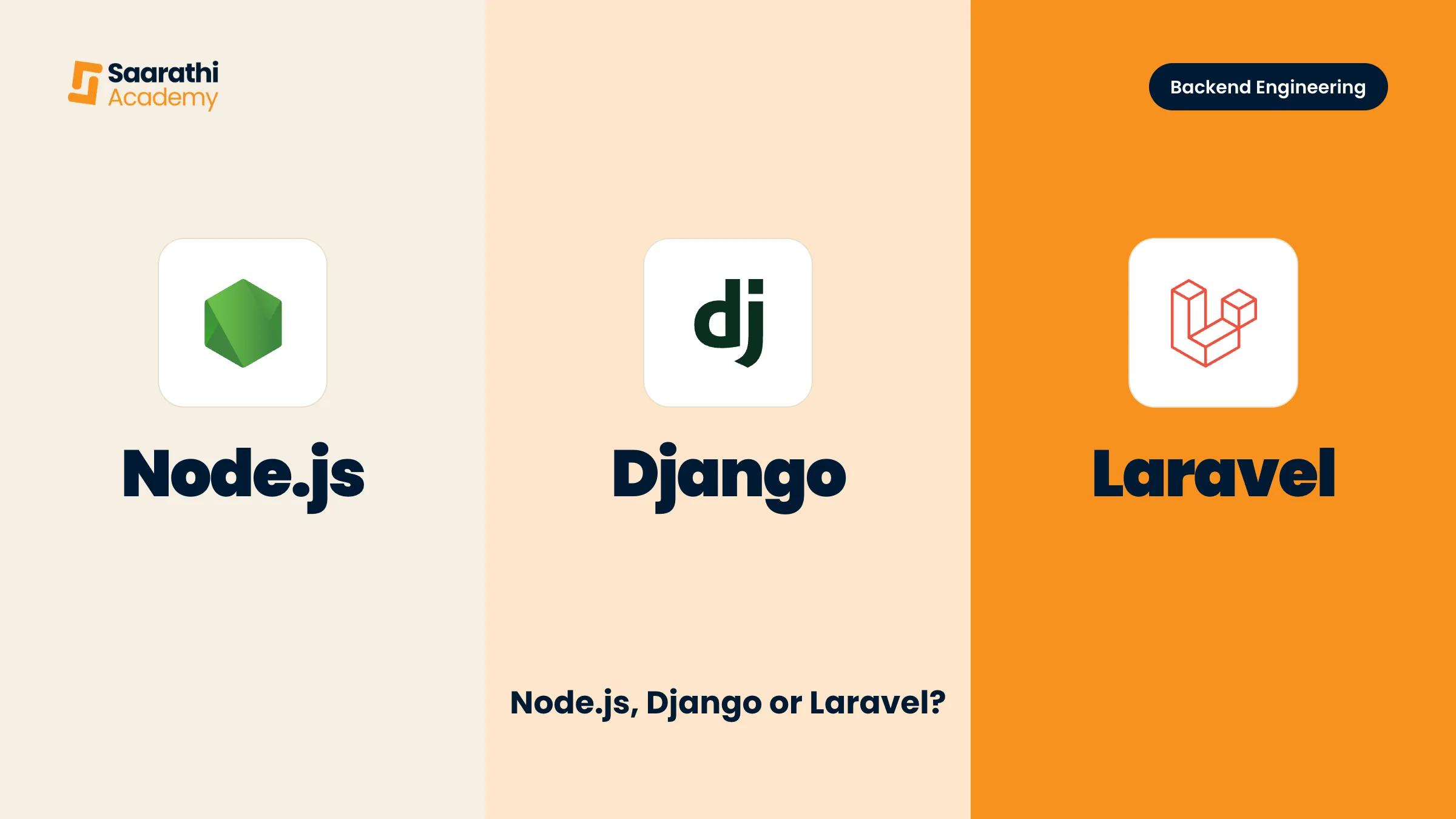
Node.js, Django and Laravel are all solid choices, and real companies run on each of them. The right first pick depends mostly on the language you want to use and the jobs you want to apply for. Node.js uses JavaScript, Django uses Python and Laravel uses PHP. Pick one, learn it properly, and the core backend skills will carry over to the other two later.
One honest note before we start: our Backend Engineering course teaches Node.js with TypeScript. It does not teach Django or Laravel. This comparison is still fair to all three.
What each one is
Node.js is a runtime, a program that lets JavaScript run on a server instead of only in a browser. On its own it is quite bare, so people add a framework on top. Express is small and flexible. NestJS gives a larger, more structured layout.
Django is a web framework for Python. It comes "batteries included", which means many common parts are already built in: a way to talk to the database, user login, and a ready-made admin panel for managing data.
Laravel is a web framework for PHP. It is also batteries included, with its own database layer called Eloquent, a command-line helper called Artisan, and Blade for building pages.
Side by side
| Node.js (Express or NestJS) | Django | Laravel | |
|---|---|---|---|
| Language | JavaScript or TypeScript | Python | PHP |
| Style | Express: pick your own pieces. NestJS: structured and opinionated. | Batteries included, with one clear way to do most things | Batteries included, with tidy conventions |
| Good for | APIs, real-time features like chat and live updates, teams that use JavaScript on the frontend too | Data-heavy apps, admin dashboards, projects close to data or AI work in Python | Business websites and web apps, and teams already working in PHP |
| Learning curve | Easy to start. Async code and the many choices take time. | Gentle if you know Python. You learn its way of doing things. | Gentle once you know basic PHP. Lots of built-in features to learn. |
| Same language on the frontend? | Yes | No | No |
A word on TypeScript, since it comes up a lot with Node.js. TypeScript is JavaScript with types added, so you say up front that a value is a number, a piece of text or a user record. The editor then warns you about many mistakes before the code ever runs. Python and PHP have their own optional type hints that do a similar job. Many Node.js teams now write TypeScript by default, so it is worth learning early if you choose Node.js.
What matters more than the framework
Beginners often worry about picking the wrong framework. The bigger skills are the same in all three:
- How the web works: HTTP requests, responses and status codes.
- Building a clean API, the door an app knocks on to ask a server for data.
- SQL and good database design.
- Login, passwords and basic security.
- Caching, background jobs and handling errors well.
- Git, the Linux terminal and deploying your app.
Someone who knows these well in Node.js can pick up Django or Laravel in a few weeks. Someone who only memorised one framework's commands will struggle anywhere. To see what this work looks like day to day, read what does a backend developer do.
A first project to build in any of them
Whichever you pick, build the same kind of first project: a small API for something you understand, such as a library, a hostel booking list or a shop's stock. Give it these parts:
- Create, read, update and delete records, saved in a real SQL database.
- User sign-up and login, with passwords stored safely.
- Input checks, so bad data gets a clear error instead of a crash.
- A few automated tests.
- Deployment to a real server, with a README that explains how to run it.
That one project touches nearly every core backend skill. Building it in a second framework later is also a quick way to compare them for yourself.
Common beginner mistakes
- Watching tutorials without building. You learn backend by fixing your own errors, not by watching someone else avoid them.
- Skipping SQL. Every one of these frameworks talks to a database. Weak SQL shows up quickly.
- Ignoring security. Store passwords hashed, check every input, and never put secret keys in your code on GitHub.
- Never deploying. An app that only runs on your laptop is half finished.
How to choose
- You already know some JavaScript, or want to build full apps later: start with Node.js. One language covers the screen and the server.
- You already know Python, or lean towards data and AI: start with Django. Python is the main language in those fields.
- You know some PHP, or the jobs you want ask for it: start with Laravel.
- You know none of them: look at 20 real job posts you would actually apply for, in Nepal or remote, and count which stack they ask for. Let that decide.
Whatever you choose, stay with it until you have built and deployed two or three real projects. Switching frameworks every month is the most common way to learn nothing well.
Where our course fits
Backend Engineering runs for 10 weeks and needs no coding experience. It teaches JavaScript and TypeScript from zero, then Node.js, Express, NestJS, PostgreSQL, MongoDB, Prisma, Redis, authentication, system design and Docker, and ends with a deployed project. If you have set your mind on Django or Laravel, this course is not the right fit, though the database, API and system design parts apply to any stack. For more on choosing an IT path, read Career in IT in Nepal: the main jobs and how to start.