Nepal's tech job market moves faster than most university syllabi can update. Fintech companies, software houses and digital agencies in Kathmandu are not hiring for general degrees. They post jobs for specific skills a candidate can prove, and those jobs often stay open for weeks because nobody suitable applies.
If you are about to sign up for professional IT courses in Nepal, this guide covers three things: the five skill areas employers want most in 2026, what each one pays in Nepal, and what a good portfolio looks like in each area.
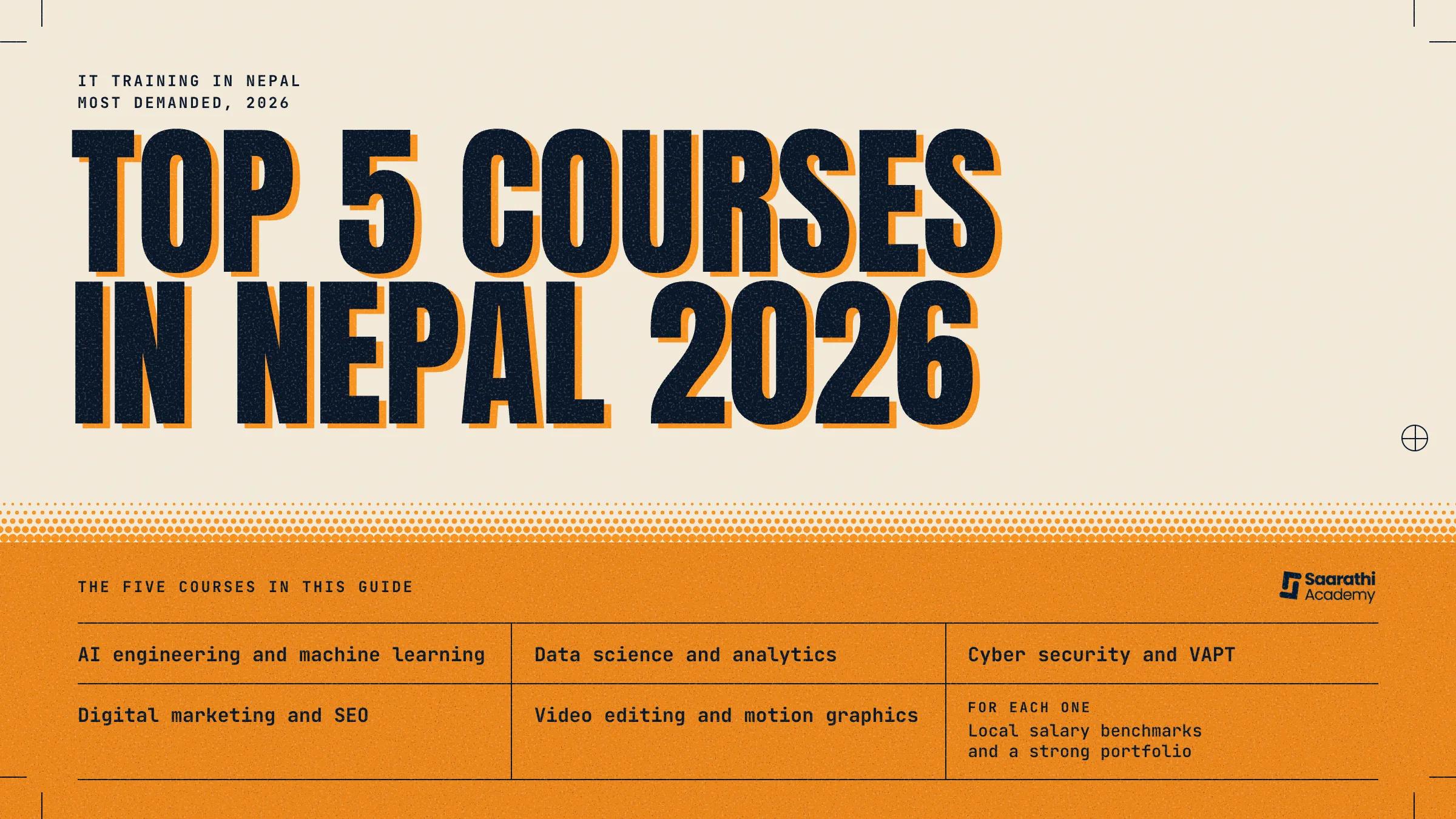
The most demanded courses in Nepal right now are AI engineering & machine learning, Data science & analytics, Cyber security & VAPT, Digital marketing and SEO, and Video editing & motion graphics.
What is driving demand for these skills in Nepal?
Three trends working together explain why these in-demand IT skills in Nepal are so far ahead of the rest of the job market.
The first is outsourcing. More foreign agencies and product companies are setting up delivery teams in Kathmandu and Lalitpur, because skilled people here cost less for the quality they deliver, as long as they have the right specialisation. Most of that outsourced work falls in the five fields below.
The second is that Nepal's own private sector is going digital. Banks, insurance companies, online shops and healthcare providers are all partway through that change, and all of them want people who can actually do the work instead of only talking about it.
The third is automation, which is shrinking the list of skills companies will pay for. General digital skills and basic coding are becoming cheap and common. Deep, practical expertise still pays well, and that is what the courses below build.
AI engineering & machine learning
For companies, AI is now an operational priority they act on today, where it used to be a long-term plan. Clients are pushing software firms in Nepal to add AI features to the products they already sell. Those firms need engineers who can build real AI systems, which takes more than connecting an outside API to existing software.
The hardest person to hire right now is an AI Engineer who knows full-stack work and has experience with vector databases, training pipelines, retrieval-augmented generation (RAG) and checking the quality of AI output in production.
Even the best IT training in Kathmandu has only started to take this gap seriously.
Entry-level salary (Nepal): NPR 40,000 to 80,000 a month
Senior or remote salary: NPR 1,500,000+ a year
What a strong portfolio looks like
Build an LLM application that uses RAG on a real dataset and put it online. A dataset from one field, such as legal, financial or medical records, is best. Employers want proof that you can handle bringing in the data, choosing how to chunk it, embedding it, getting good retrieval and evaluating the results. A live demo link and a GitHub repository with clear documentation count for much more than a certificate.
Core skills to develop
Basics of Python and PyTorch or TensorFlow
Fine-tuning workflows and prompt engineering
Vector databases (Pinecone, Weaviate or Chroma)
Evaluating models and deploying them through APIs
AI engineering sits at the intermediate to advanced level. If you have never programmed, expect six to nine months of groundwork before this track starts paying off for you.
Data science and analytics course
Nepal Rastra Bank, business groups and online shops produce huge amounts of transaction data daily. Most of it sits unused because these organisations do not have people who can clean it, build models from it and present results that lead to real decisions. That is where the opportunity lies.
Data science needs solid statistics as well as technical skill, so there are fewer truly capable candidates than in plain software development. Because supply is lower, strong candidates who finish a credible, career-focused course in Nepal tend to get hired quickly.
Entry-level salary (Nepal): NPR 30,000 to 50,000 a month
Experienced analyst salary: NPR 1,20,000+ a month
What a strong portfolio looks like
Take a real business problem and build a predictive model for it, regression or classification, then add an interactive dashboard that explains the results to people who are not technical. Explaining the insight matters as much as how accurate the model is. Employers hire people who can say what the data means, and a model's raw output does not do that on its own.
Core skills to develop
Python with NumPy, pandas and scikit-learn
SQL at an advanced level for business reports
Statistical thinking and the basics of A/B testing
Data visualisation in Tableau, Power BI or Plotly
Cyber security & VAPT
Digital wallets, internet banking and business SaaS platforms are now part of Nepal's core infrastructure. The area open to attack has grown with them, and one breach can cause legal, financial and reputation damage that takes years to repair. Companies now treat security as a priority from the start.
Fintech companies and banks are setting up their own vulnerability assessment and penetration testing (VAPT) teams, so demand has jumped for a trustworthy cybersecurity course in Kathmandu and across Nepal. Qualified people are so scarce that certified junior analysts get hired fast, on pay close to what more senior roles earn.
Junior analyst salary (Nepal): NPR 40,000 to 70,000 a month
What a strong portfolio looks like
Run a penetration test on a practice network and write it up as a report for a made-up company. Rank the weaknesses you found by severity, show the steps that prove each one can be exploited, and finish with short, plain-language fixes that a non-technical manager can follow. In interviews, the report is what sets candidates apart: how it is organised, how clear it is and how professional it looks.
Core skills to develop
Network security basics and reading network packets
Ethical hacking tools: Nmap, Burp Suite, Metasploit
The OWASP Top 10 and web application security
Professional VAPT report writing
You cannot learn cybersecurity from lectures alone. You need hands-on time in a safe, controlled lab. Pick a course that puts you in the lab from the first week.
Digital marketing and SEO
Retail chains, hospitals, schools and restaurants in Nepal all need to be visible online if they want to grow, which is why so many people search for a good Digital marketing course in Kathmandu. But employers now expect more than the basics. Running a Facebook page is no longer enough to get hired.
They want someone who can run paid campaigns that make money, read the analytics and grow organic traffic in a planned way.
Performance marketing and technical SEO pay the most. Entry-level freelance and remote work is easier to find in these areas, so they are the fastest route to earning international rates when you are new to the field.
In-house executive salary: NPR 20,000 to 35,000 a month
Freelance or remote retainer: $500 to $2,500 a month (USD)
What a strong portfolio looks like
Write a case study that tracks 90 days of growth with results you can measure: organic traffic you gained with semantic keyword mapping, plus a paid campaign where you tracked ROAS and cost per acquisition. Real numbers with context will always beat theory. If you have handled an actual account, even a tiny one for a nearby shop, record everything about it.
Core skills to develop
Technical SEO: structured data, site audits, Core Web Vitals
How to structure Google Ads and Meta Ads campaigns
GA4 reports and attribution modelling
Conversion rate optimisation and reviewing landing pages
Video editing and motion graphics
Video is the main type of content on every platform, from YouTube and Instagram Reels to TikTok and company communications. Media and advertising agencies in Nepal are under pressure to produce more content faster, so they hand post-production to outside editors who can deliver without close supervision.
Employers separate editors who just assemble clips from storytellers who understand retention, pacing and sound. Motion graphics, especially 2D animation in After Effects, earns the most, and it is the skill most agencies are short of.
Junior editor salary (Nepal): NPR 15,000 to 30,000 a month
Motion graphics specialist salary: NPR 80,000+ a month
What a strong portfolio looks like
Make a showreel that shows your range. Include a short commercial with tight editing and a clear story, a cinematic piece where the sound design stands out, and one or more vector animations made in After Effects.
A recruiter decides what they think of a showreel in about 20 seconds, and the first 10 seconds largely decide whether they watch the rest.
Core skills to develop
Adobe Premiere Pro: multi-camera edits, export, colour grading
After Effects: compositing, motion graphics, expressions
Mixing audio and the basics of sound design
Pacing and keeping viewers watching in social video formats
The Saarathi Academy difference: learning environment matters
Whether a course leads to a job depends on more than the syllabus. The quality of teaching and the classroom setup matter just as much, especially for the more technical tracks above.
You cannot learn cybersecurity or AI engineering well in a lecture hall of thirty students. You need a teacher who looks at your own code and your own lab results and tells you directly what to fix. In big batches that cannot happen, however good the course plan is.
At Saarathi Academy for Digital Excellence in Old Baneshwor, Kathmandu, we cap every intake at ten students. Before the course starts, each student takes a diagnostic assessment, and the instructor uses it to set the pace and depth. Every track finishes with a portfolio project the student builds to production standard, which the mentor reviews in detail, plus mock interview practice.
When you compare professional IT courses in Nepal, how much instructor time each student gets is the best single sign of how well a course will get you ready for real work.
Want to know more about these courses?
Picking a tech track is a big career decision. Do not guess at your strengths or sit in a crowded IT factory of 40 students.
Talk to our tech mentors and see how we teach through projects in batches of 10 students at most.
Start your Saarathi Academy admission request
Note: each batch is capped at 10 seats so every student gets close one-to-one mentoring.