
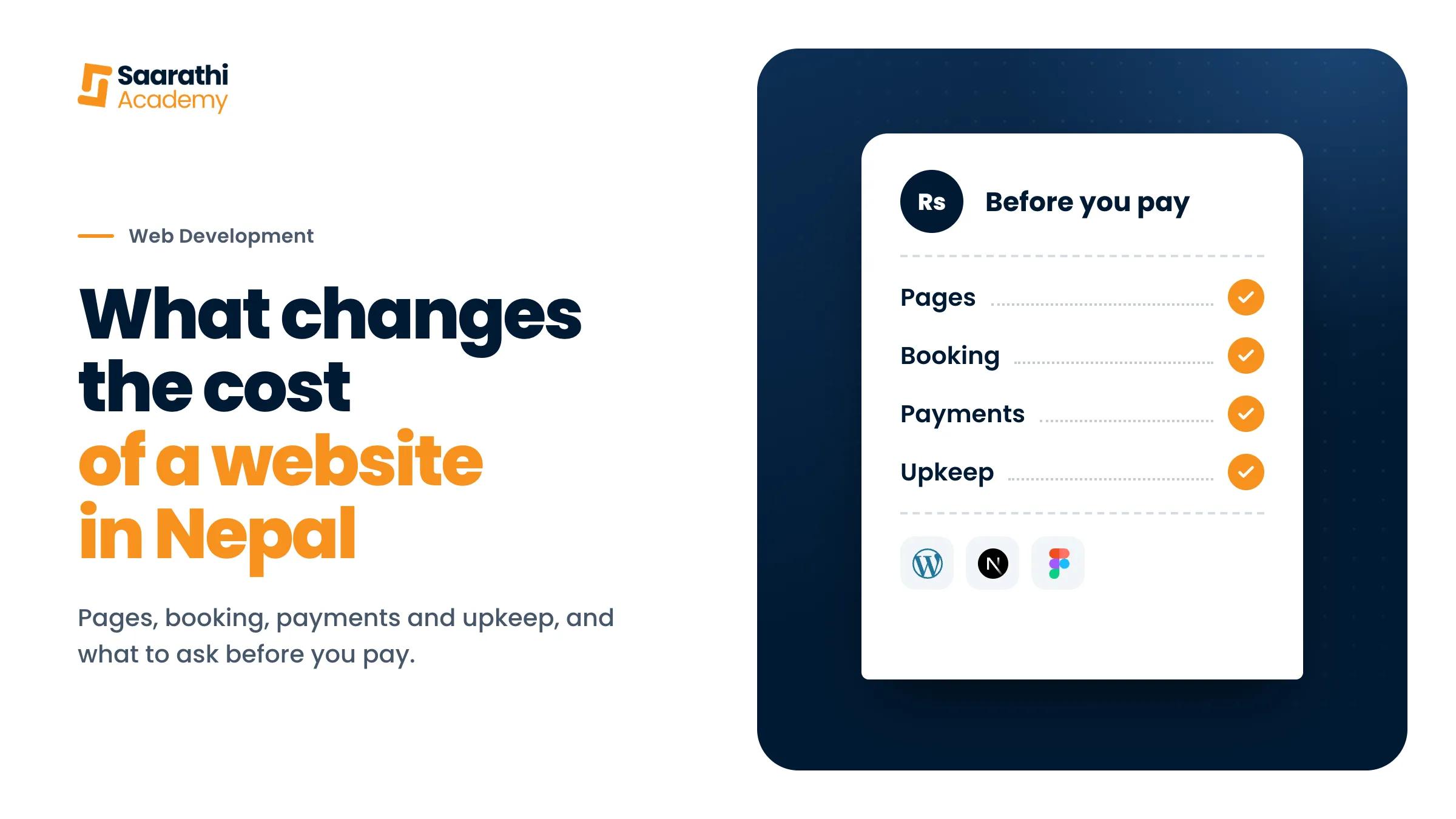
Ask five web companies in Kathmandu what a website costs and you will get five very different numbers. Most of the time they are not pricing the same thing. One quote is for a few pages on a ready-made theme. Another is for a design of your own with online booking and payments. This guide lists what changes the price, so you can compare quotes properly.
We build websites too, and we don't publish a price list, because two sites are rarely the same job. What we can show you is what goes into the number.
1. How many pages, and who writes them
A home page, an about page, a services page and a contact page make a small job. Every extra page adds design and build time. Pages that each need their own layout, like a product page or a menu, add more than pages that share one.
The writing matters as much as the building. If you hand over the text and photos ready, the job is shorter. If the developer has to write the words, take the photos or chase you for them, that time is in the quote, or it should be.
2. A ready-made theme or a design of your own
A ready-made theme (a template many sites share) is cheaper and faster. A design made for your business costs more, because someone plans each screen before anyone builds it. Both can look good. What matters more is that it reads well on a phone, because that is where most people will open it.
3. Forms, booking and a dashboard
A contact form that sends you an email is simple. Online booking is more work. The site has to know which slots are free, stop two people taking the same one, and show you the bookings somewhere. That somewhere is a dashboard, a private page where you see and manage requests. A dashboard is often the biggest single item in a quote, because it is a small piece of software of its own.
4. Online payments with eSewa, Khalti or cards
Taking money on the site means connecting a payment service such as eSewa, Khalti or a card gateway. Each needs a merchant account in your business's name. The site also has to deal with a payment that fails halfway or gets refunded. Ask whether the quote covers those cases, and not only a payment that goes through.
5. Updating the site yourself
If you want to change prices, photos or text without calling a developer, the site needs an editing screen, and that takes setup time. If you will rarely change anything, you may not need one, and the developer can make the odd change for you.
6. Nepali and English
A site in two languages is close to two sets of pages. Every page needs its text in both, and the site needs a way to switch between them. Decide early, because adding a second language later costs more than planning for it from the start.
7. Connections to other tools
A WhatsApp button is quick. Sending every enquiry into WhatsApp, a spreadsheet or a customer list on its own takes more work. So do maps, the Facebook and Google tracking you need for ads, and email newsletters. List the ones you need before you ask for quotes, so every company prices the same thing.
8. Domain, hosting and email
These are yearly costs, separate from building the site. The domain is your address on the web. Nepali businesses can register a .com.np address free of charge at register.com.np, while a .com has a yearly fee. Hosting is the server the site lives on, and its price depends on how busy the site gets. Business email, like you@yourbusiness.com.np, is another yearly cost if you want it. Ask who will hold each of these logins.
9. Upkeep after launch
A website is not finished on launch day. Its software needs updates, backups need to run, and sooner or later something breaks. Some companies include a year of upkeep, some charge every month, and some charge for each fix. Two quotes that look far apart can end up close once you add the upkeep.
What to ask before you pay
- Is the price fixed and written down, with the list of pages and features?
- When will it be ready?
- Who owns the domain, the hosting login and the code once it is paid for?
- What does upkeep cost after launch, and what does it cover?
- Can I see a site you built that is live now, and open it on my phone?
Be careful with anyone who promises your site will be first on Google. Nobody controls that. A good developer builds pages Google can read, and ranking for a search takes time and ongoing work.
How we price a website
We start with a short call about what the site is for. Within a few working days you get the page list and a fixed quote in writing, before any work starts. A business website usually takes 2 to 3 weeks, and a site with a booking dashboard 3 to 6 weeks. Once it is paid for, the site, its code and every login are yours. See how we build websites.