Search for data science training in Kathmandu and you will find many institutes making almost identical promises. Job-ready in three months. Industry experts. Placement support. The brochures use the same words, most hide the fee behind an enquiry form, and very few tell you what you will actually be able to do on the last day.
That leaves you comparing marketing rather than comparing training.
This guide is written to fix that. It sets out what a serious syllabus must contain, how long the work honestly takes, what the fees should include, and which questions separate a strong institute from a weak one. The ten-point checklist in section eight works for any provider in Kathmandu, including us. Use it on every shortlist you build.
Who data science training is actually for
Most people who enrol in data science training in Kathmandu fall into one of three groups.
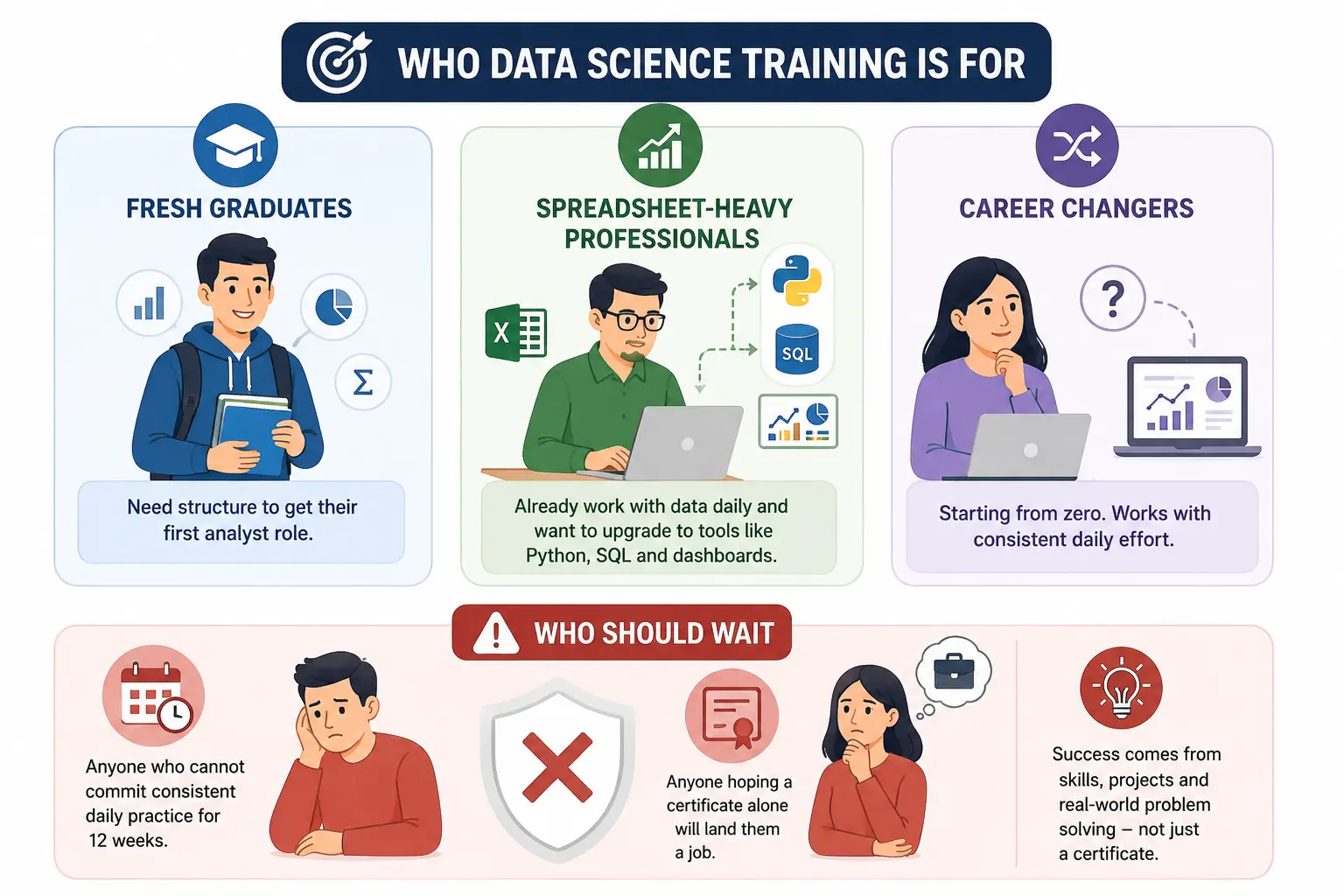
Fresh graduates: from commerce, engineering, statistics, economics or IT who want a first analyst role and need structure more than they need content. Free content is abundant. Feedback is not.
Spreadsheet-heavy professionals: in finance, operations, marketing or NGO reporting who already work with data daily and want to move beyond Excel into Python, SQL and dashboards. This group usually progresses fastest, because they already understand the business questions.
Career changers: from unrelated fields who are starting from zero. This works, but only with a realistic time commitment of roughly four hours a day for three months.
Who should wait: anyone who cannot commit consistent daily practice for twelve weeks, and anyone hoping a certificate alone will produce a job offer. Neither is how hiring works in this market. Honest disqualification saves you money, so treat any institute that tells you the course suits absolutely everyone with some caution.
What a complete Data science curriculum must cover
This is where most comparisons should be won or lost. A syllabus that lists only topic headings such as "Python" and "Machine Learning" is telling you very little. A serious syllabus names specific libraries, tools and outputs.
Seven modules should appear in any credible data science training in Nepal
Module | What it should cover | Why it matters |
Python foundations | Jupyter, functions, pandas, NumPy, debugging | Every later module depends on it |
Statistics and EDA | Distributions, hypothesis thinking, exploratory analysis | Separates analysts from report generators |
SQL and databases | Joins, aggregation, window functions, PostgreSQL | The single most-used skill in analyst jobs |
Visualization and BI | Matplotlib, Seaborn, Plotly, Power BI, DAX | How findings actually reach decision makers |
Machine learning | Regression, classification, clustering, evaluation | The differentiator once foundations are solid |
Working habits | Git, GitHub, documentation, project structure | What makes your work reviewable and trusted |
Capstone project | End to end on real data, reviewed one to one | The portfolio piece employers ask to see |
Two things get skipped in weak short courses. The first is Power BI in genuine depth, which matters because it is the most frequently named BI tool in Kathmandu job postings. Look for Power Query, star-schema data modelling, DAX measures, publishing with scheduled refresh, and Row-Level Security, ideally aligned to the Microsoft PL-300 Power BI Data Analyst exam outline. The second is version control. If Git and GitHub are not in the syllabus, your work will live as disconnected files on a laptop and cannot be shown to an employer.
Also check the sequencing. Machine learning taught before pandas, SQL and statistics produces learners who can import a model library but cannot clean a messy dataset. That order is a reliable quality signal.
If you want the detail on which Python libraries genuinely matter at the start, read our companion guide, Python for Data Science: The Only Libraries You Actually Need to Start.
Data Science Training in Kathmandu: Duration, format and batch timing
Most institutes run two to three months. Twelve weeks at roughly two hours of live class per day, five days a week, plus two hours of independent practice, comes to around 120 hours of guided work and a similar amount of self-study. That is a realistic answer to the data science course duration Nepal question, and it is enough to reach competent junior analyst level, not enough to reach senior data scientist. Any provider claiming otherwise is overselling.
Format matters as much as length:
In person gives you peer pressure, pair programming and immediate help when you are stuck. Completion rates are consistently higher.
Live online suits people outside the valley or in inflexible jobs, and often costs less.
Recorded only is the cheapest and has by far the worst completion rate. Without a feedback loop, most learners stop around week four.
Ask about batch timing before you pay. Morning batches suit students, evening batches suit working professionals, and weekend-only formats stretch the same content across a much longer calendar.
Prerequisites: what you genuinely need to join Data Science Training in kathmandu
The maths requirement is routinely overstated. For analyst-level work you need comfort with percentages, averages, basic probability and the idea of a distribution. Linear algebra and calculus matter for research and deep learning, not for your first data job. If an institute tells you that you need an engineering background, they are describing their teaching limits, not the field.
Programming experience is not required, but zero exposure makes week one harder than it needs to be. Before any batch starts, work through the first few sections of the freeCodeCamp Scientific Computing with Python certification. Two weekends of preparation changes your entire first month.
A quick readiness check. Can you commit four hours a day for twelve weeks? Are you comfortable being confused for several days at a time? Can you install software and follow written documentation? Do you actually enjoy questions about why a number moved? If you answered yes four times, you are ready.
Projects and portfolio outcomes
A certificate on its own does not get interviews in Nepal. What gets interviewed is a portfolio a hiring manager can open and inspect.
The test to apply is simple: are the projects original, or are they the same three tutorial datasets every institute uses? Titanic survival, the iris flowers and a housing price notebook signal that a batch copied along with an instructor. Strong project work looks like a retail sales forecast built from a real business's transaction history, a Power BI dashboard for an NGO's programme reporting, or a churn analysis on telecom-style data with a written recommendation attached.
Two questions worth asking any institute:
Can I see a capstone project from your last batch?
Is the project reviewed one to one, or only marked pass or fail?
Reviewed work is the difference between a course and a video playlist. Reasoning quality, not whether the code runs, is what an employer is assessing.
Career paths after training in Nepal
Is data science a good career in Nepal? Yes, with a qualification. Banking, fintech, telecom, e-commerce, healthcare, NGOs and product companies are all hiring for reporting, analytics and dashboard work. What is comparatively rare locally is the pure research data scientist role. The realistic entry points are:
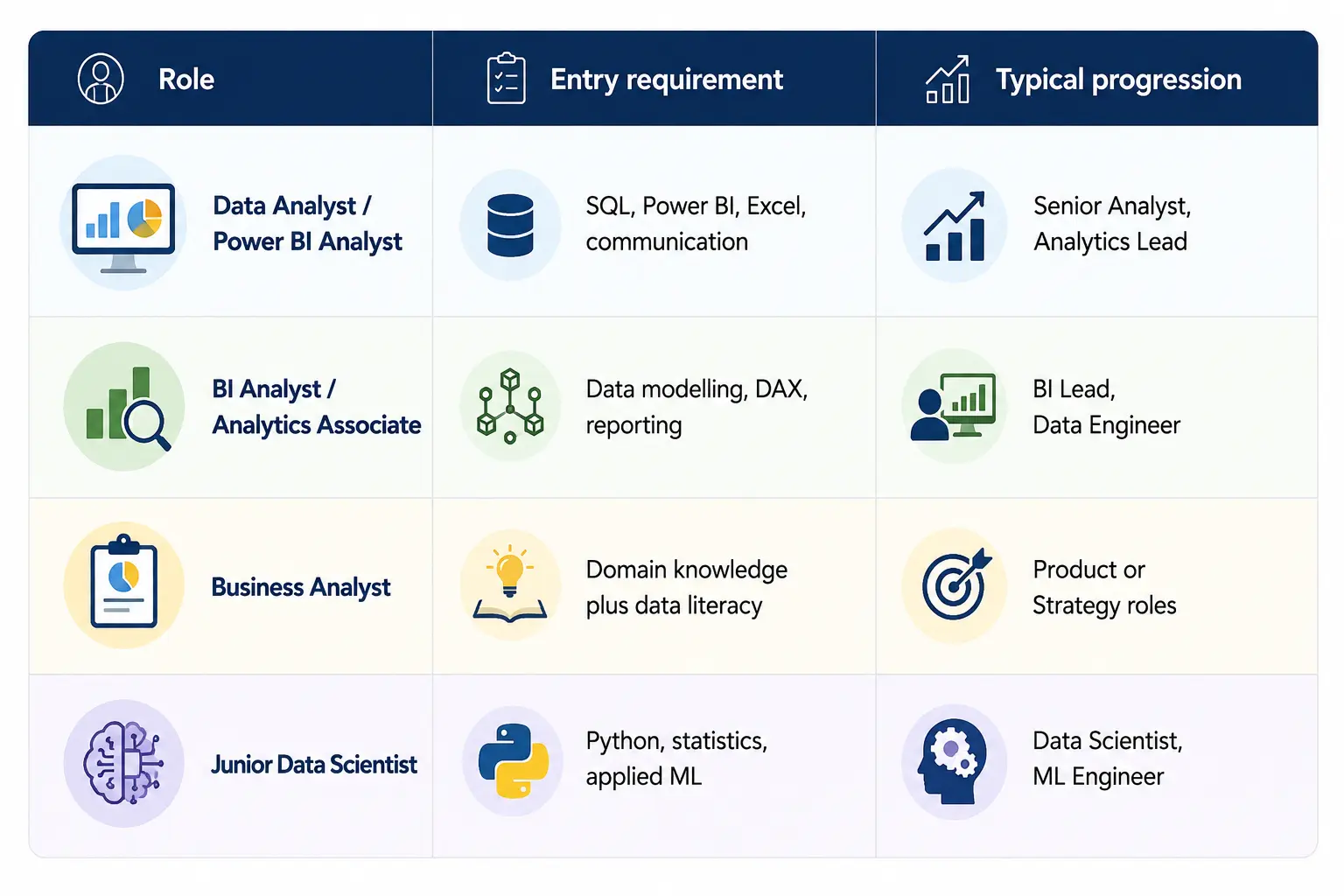
The second route is remote and contract work with international clients, and it is a significant share of real demand. That market screens on demonstrated work rather than credentials, which is another reason the portfolio matters more than the certificate. On timelines, expect three to six months from course completion to a first role for someone applying consistently with a finished portfolio. Anyone promising placement in thirty days is describing an exception as if it were the rule. If you are still deciding between an analytics track and an AI track, our guide AI vs Data Science: Different Jobs, Different Skills, Different Salaries breaks down where the two paths diverge. |
Fees and what should be included
The data science course fee Nepal range for a serious twelve-week programme sits roughly between NPR 25,000 and NPR 45,000. Below that range, batch sizes are usually large and feedback thin. Above it, you should expect certification, one-to-one review and career support included rather than sold separately.
What should be bundled in the quoted price:
All course materials and datasets
Mentor review of your work, not just attendance
Capstone project supervision
A certificate, and a stated way for employers to verify it
CV and LinkedIn review, and mock interview practice
What to ask about before paying: separate examination fees, charges to repeat a missed batch, software licence costs, and whether instalments are available.
One practical filter. An institute that publishes its fee openly on the website has made a decision to be compared. An institute that hides it behind a form is planning to price you individually. That is a reasonable signal about how the rest of the relationship will go.
The checklist: how to evaluate any institute in Kathmandu
This is the part to save. It applies to every provider, and it is the honest answer to how to choose data science course in Kathmandu.
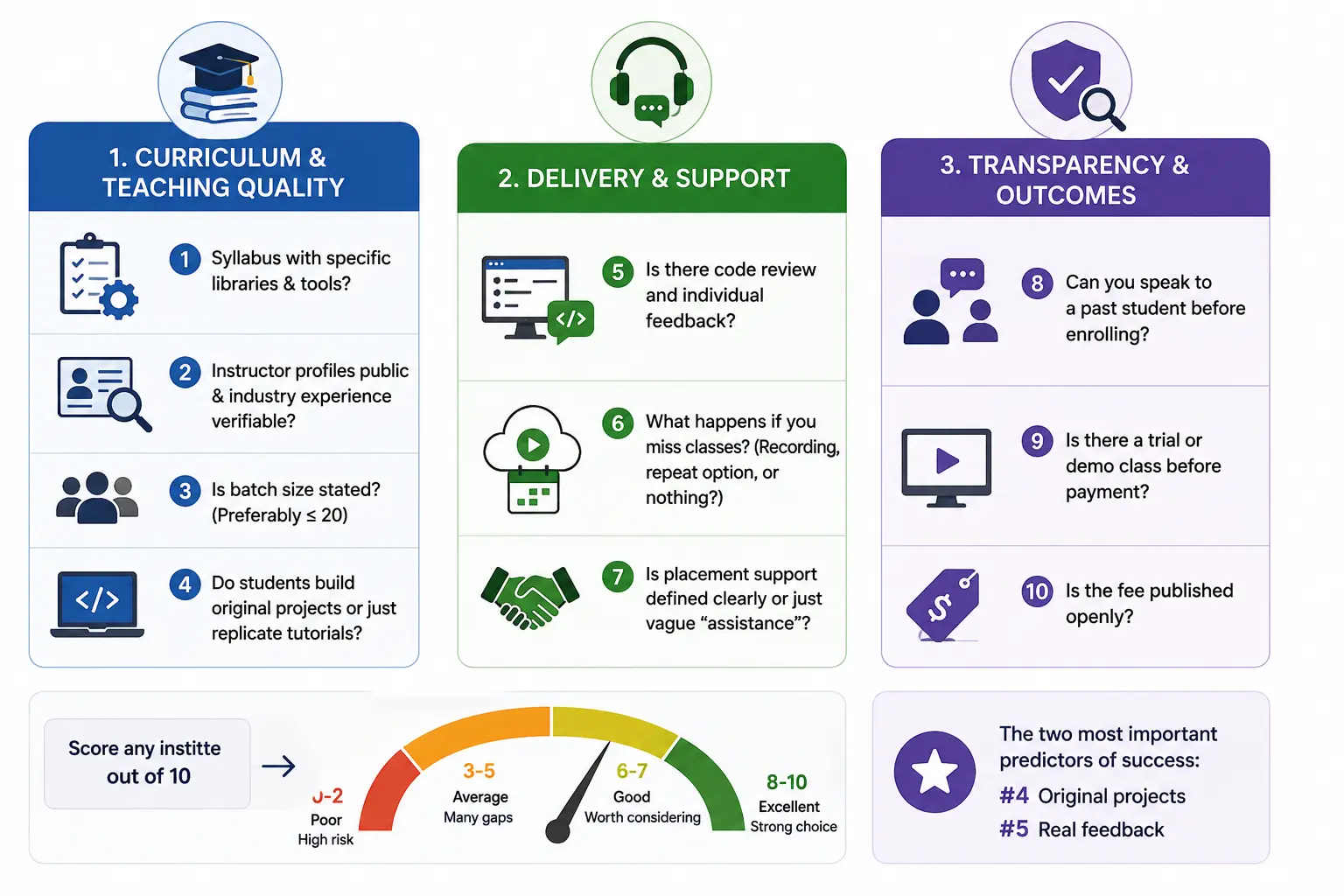
Curriculum and teaching quality
Does the syllabus name specific libraries and tools, or only topic headings?
Are instructor profiles public, with verifiable industry work you can check on LinkedIn?
Is the batch size stated? Anything above twenty means limited individual attention.
Do students build original projects, or replicate tutorials?
Delivery and support
Is there code review and individual feedback, or only lectures?
What happens if you miss classes? Is there a recording, a repeat option, or nothing?
Is placement support defined concretely, or described vaguely as "assistance"?
Transparency and outcomes
Can you speak to a past student before enrolling?
Is there a trial or demo class before payment?
Is the fee published openly?
Score any institute out of ten. In practice, most Kathmandu providers score between three and five. Anything at seven or above is worth a serious conversation. The two points that predict outcomes most reliably are numbers four and five, because original work plus real feedback is what actually produces capable analysts.
Building skills after the course ends
The first ninety days after training decide whether the investment converts. Ship one new project a month, contribute to a public dataset analysis, work through problems on Kaggle, and keep your GitHub active. Employers check commit history.
This is also where self-study alone tends to stall. Not from a shortage of material, but from the absence of anyone telling you that your approach is wrong before you have spent three weeks on it.
For a structured plan covering what to learn after the fundamentals, see our Machine Learning Roadmap: A Month-by-Month Plan From Zero to First Model.
How Saarathi Academy measures against the checklist
We wrote the checklist to be used on us as well, so here are our answers in full.
The Data Science and Machine Learning course in Nepal runs twelve weeks, two hours a day, five days a week, across four phases: analyst foundations, statistics and EDA, business intelligence with starter machine learning, and capstone with career preparation. The full syllabus naming every library and tool is published and downloadable. Power BI gets a dedicated week aligned to the PL-300 outline, covering Power Query, data modelling, DAX, Row-Level Security and Copilot in Power BI.
Batches are capped at ten students. Work is reviewed weekly by a mentor, and the capstone is reviewed one to one. The Sunday Open Classroom keeps labs available all day for practice and pair programming.
Tuition is NPR 35,500, currently NPR 33,750, published on the course page rather than quoted privately. Live online is available at a 25 percent discount. Included are the certification exam, a capstone project, a CV and LinkedIn audit, a one-to-one mock interview, and hiring-network referral. Saarathi Academy Classes run in person at Old Baneshwor, and you are welcome to visit before you commit.
Frequently asked questions
Q: Can I learn data science without a programming background?
A: Yes. A properly sequenced course starts with Python fundamentals and assumes nothing. What matters more than prior coding is the willingness to practise daily. Completing a few sections of an introductory Python course beforehand makes your first two weeks considerably easier.
Q: How long does data science training in Kathmandu take?
A: Twelve weeks is the standard for a complete beginner-to-analyst programme, at around two hours of class and two hours of independent practice per day. Shorter courses usually cut either statistics or the dashboard and BI component, both of which employers screen for.
Q: What is the fee for a data science course in Nepal?
A: Expect roughly NPR 25,000 to NPR 45,000 for a full twelve-week programme. Compare what is included rather than the headline number, since certification, project supervision and interview preparation are sometimes charged separately.
Q: Is data science a good career in Nepal right now?
A: Yes, particularly for people who combine Python and SQL with dashboard skills and clear business communication. Banking, fintech, telecom, e-commerce and NGOs are the most active hiring sectors, and remote work with international clients is a growing second route.
Q: Should I learn Python or R first?
A: Python, for almost everyone in this market. It dominates local job postings, carries into machine learning and automation, and has a far larger ecosystem. R remains excellent for academic statistics but is rarely a hiring requirement in Nepal.
Q: Is a certificate enough to get hired?
A: No. A certificate confirms you completed a programme. Employers hire on evidence, which means a reviewed capstone project, a visible GitHub profile, and the ability to explain your analytical choices in an interview. Choose training that produces those three things.
Before you enrol
Shortlist three institutes. Run all three through the ten-point checklist. Attend a demo class at each, ask to see a capstone project from the most recent batch, and ask for the fee in writing. The provider that answers all three requests directly is usually the one worth choosing.
If you would like to see how our batch runs before deciding, book a free consultation or visit us at Old Baneshwor, Kathmandu.
Related reading: Python for Data Science | Machine Learning Roadmap | AI vs Data Science


