Search “Roadmap of machine learning training in Kathmandu” and you get a wall of things to learn with no order and no honest timeline: a YouTube playlist here, a Coursera specialisation there, a GitHub repo with forty starred links nobody has finished. None of it tells you what to do in week one, how long linear regression should actually take you, or when you’re ready to touch a real dataset instead of another toy one.
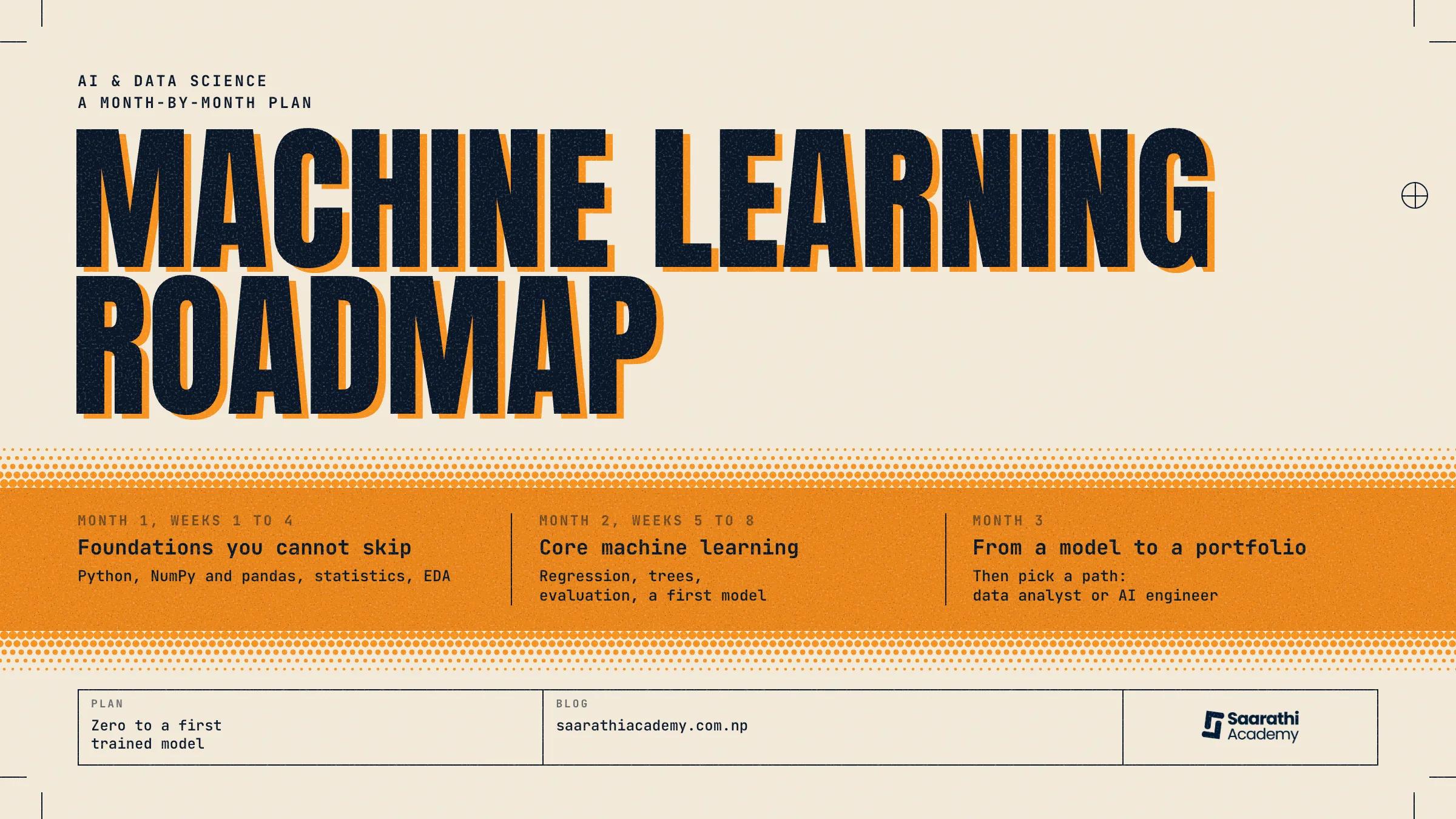
This guide replaces that wall with a plan. It is built around three months, because that is roughly how long it takes a beginner working with real structure to go from installing Python to training and explaining a first model. The plan also tells you where it branches, because “machine learning” now splits into two genuinely different careers: the data analyst or junior data scientist track, and the AI engineering track that builds on LLMs, RAG and agents. Knowing which one you’re roadmapping for changes what month three should contain.
If you’d rather follow this plan inside a structured batch than alone, this same roadmap is what our Data Science & machine learning training in Kathmandu is built around for months one and two below.
Before you start: what “zero” actually means
Zero does not mean zero mathematics knowledge and it does not mean you need a laptop that can train neural networks. It means no prior programming and no prior statistics course. What it does assume is comfort with percentages and basic algebra from school, a willingness to be stuck and confused for a few days at a stretch, and the ability to set aside close to four hours a day. Without that daily block, three months quietly becomes six, and momentum is the thing self-taught learners lose first.
A rough readiness check before month one: can you install software and read documentation without giving up. Have you ever finished a multi-week course, of any kind, rather than abandoning it around week three. Do you actually want to know why a number moved, or do you just want the job title. Two yeses out of three is enough to start.
Month 1: Foundations you cannot skip
Machine learning taught before Python fluency, basic statistics and clean data handling produces people who can call model.fit() without understanding what just happened. Month one exists to prevent that. It is unglamorous and it is where most self-taught attempts quietly stop.
Week | Focus | What “done” looks like |
Week 1 | Python fundamentals: variables, loops, functions, data structures | You can write a script without copying it line by line from a tutorial |
Week 2 | NumPy and pandas: arrays, DataFrames, filtering, grouping, merging | You can take a messy CSV and answer three questions about it unaided |
Week 3 | Statistics for ML: distributions, mean/median/variance, correlation, probability basics, hypothesis thinking | You can explain why correlation is not causation, in your own words, with an example |
Week 4 | Exploratory data analysis and visualisation: Matplotlib, Seaborn, missing data, outliers | You can take a raw dataset and produce a short written summary of what’s in it |
The most common mistake here is rushing week 3. Statistics is the part that feels least like “real” machine learning, so it gets skimmed, and the cost shows up later as an inability to explain why a model’s accuracy number means anything. Slow down on distributions and correlation specifically; almost everything in month two depends on that intuition.
Month 2: Core machine learning
This is the month most people picture when they imagine “learning ML.” The goal is not to memorise every algorithm that exists, it’s to deeply understand a smaller set and, critically, to know when each one is the wrong choice.
Week | Focus | What “done” looks like |
Week 5 | Supervised learning part 1: linear and logistic regression, train/test splits | You can explain, without notes, what overfitting is and why a test set exists |
Week 6 | Supervised learning part 2: decision trees, random forests, gradient boosting basics | You can say why a random forest usually beats a single decision tree |
Week 7 | Model evaluation: accuracy, precision, recall, F1, ROC-AUC, RMSE, cross-validation | You can pick the right metric for a given business problem, not just the highest number |
Week 8 | Unsupervised learning and your first end-to-end model: k-means clustering, feature engineering, scikit-learn Pipelines | You have one trained, evaluated model on a dataset you didn’t just copy from a tutorial |
By the end of week 8 you should have trained a real model on a dataset with actual messiness in it, not the Titanic or Iris datasets that every beginner project uses. A local retail sales file, a small NGO’s programmer data, anything with genuine missing values and outliers, teaches far more than a dataset that’s been cleaned by ten thousand tutorials before you touched it. (See scikit-learn’s documentation for the Pipelines API referenced above.)
Month 3: From a model to a portfolio, and choosing your direction
Month three is where the roadmap forks, because “I know machine learning” is not a job title. Two realistic directions open up from here, and the earlier foundations support both.
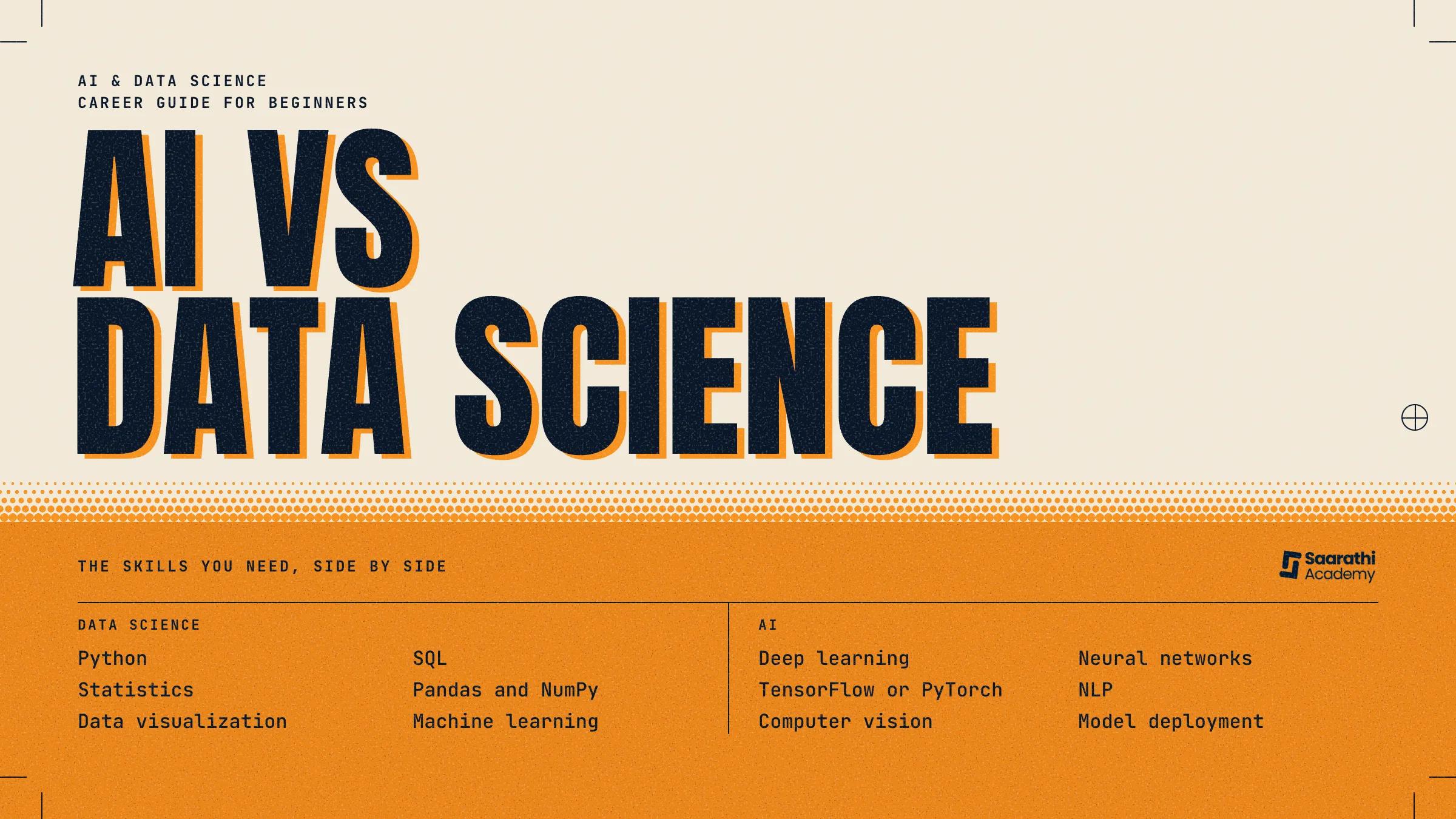
Path A: Data analyst / junior data scientist. This path adds SQL, dashboarding in Power BI, and business communication on top of the ML foundations you already have. It leads to analyst, BI and junior data scientist roles, which are the roles Nepal’s banking, telecom, fintech and NGO sectors are actively hiring for right now.
Path B: AI engineer. This path takes the same classical ML base and extends it toward deep learning fundamentals, then into working with LLM APIs, retrieval-augmented generation, agents and production deployment. It leads toward AI engineering and applied ML engineering roles, a specialisation that is growing faster than the talent pool both locally and for remote international work.
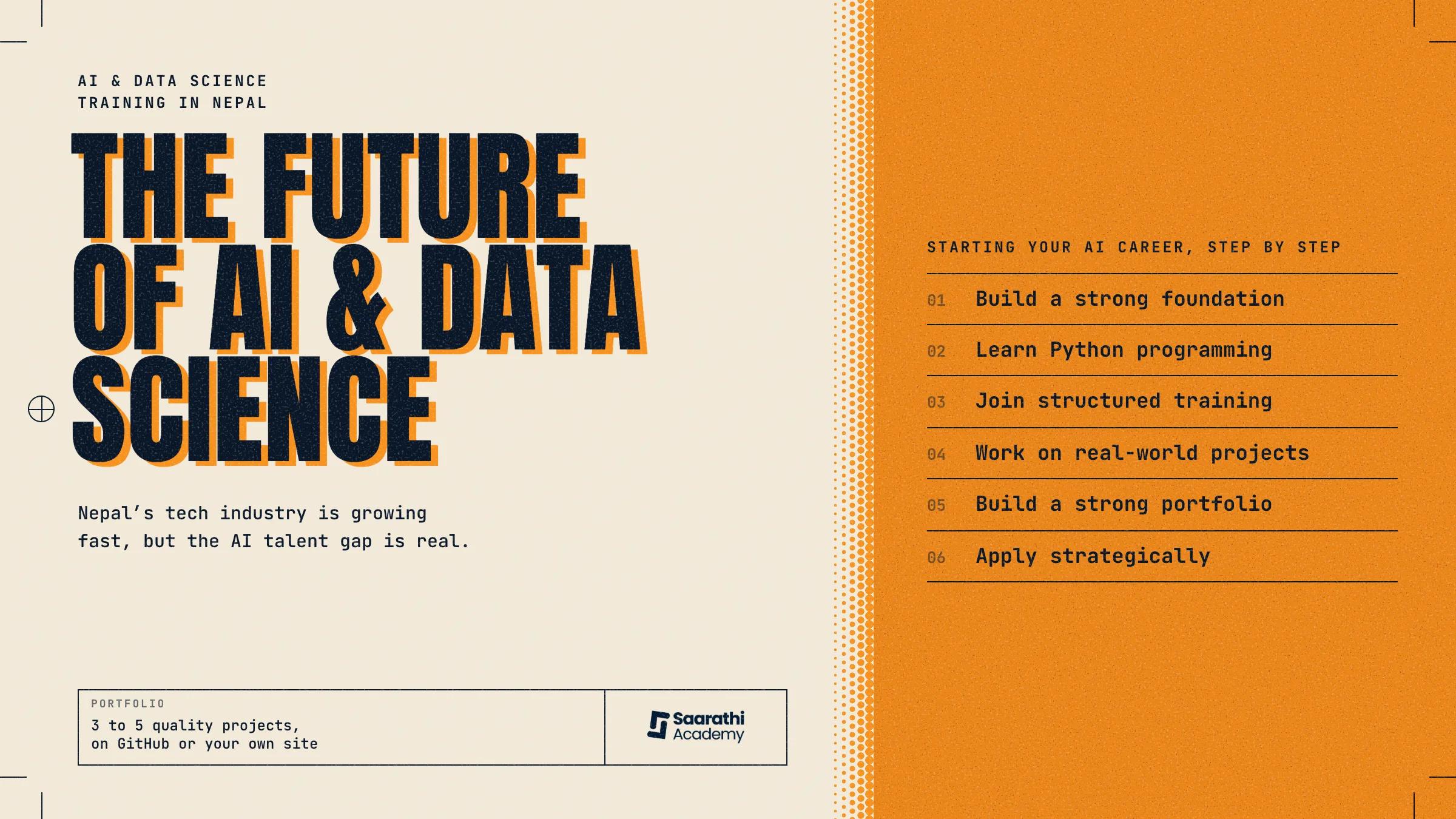
Either way, month three should include a capstone: one project, reviewed by someone other than yourself, that you can open in an interview and explain end to end, including the decisions you made and the ones you’d make differently next time. A finished, explainable project with mediocre accuracy beats an unfinished one aimed at a leaderboard score nobody will ask you about.
Comparing the two directions
Track | Builds on months 1–2 with | Typical entry role |
Data Analyst / Data Science | SQL, Power BI and DAX, business communication, applied statistics | Data Analyst, BI Analyst, Junior Data Scientist |
AI Engineering | Deep learning, LLM APIs, RAG, vector databases, agents, deployment | AI Engineering Apprentice, Junior AI Engineer, Applied ML Engineer |
If you’re still unsure which of the two fits you better, the honest answer is that Path A rewards people who like turning numbers into business decisions, and Path B rewards people who like building and shipping systems. Both start from the exact same three months above, so nothing in this roadmap is wasted if you change your mind partway through.
Where self-taught learners stall
The roadmap above is accurate, but accuracy is not the same as ease. The place self-directed learners consistently stall is not any single topic, it’s the absence of a feedback loop. You can follow this exact plan and still get stuck for two weeks on a bug that a five-minute conversation with someone experienced would resolve, or spend a month building a portfolio project that a mentor would have told you, on day one, was too similar to every other beginner’s project to stand out.
That is the actual argument for structured training over pure self-study: not that the content is different, but that someone tells you your approach is wrong before you’ve sunk three weeks into it. Our guide on how to choose data science training in Kathmandu breaks down exactly what to look for in a structured programme, including the checklist we hold ourselves to.
How Saarathi’s courses map to this roadmap
The Data Science and Machine Learning course in Nepal covers months one and two of this roadmap in full depth, then adds the Path A material: SQL, Power BI with DAX and Row-Level Security aligned to the PL-300 outline, and a reviewed capstone. It runs 12 weeks, in person at Old Baneshwor or live online, with batches capped at ten students and every project reviewed one to one. This is the batch we mean by machine learning training in Kathmandu above.
For Path B, the AI Engineering and Machine Learning course in Nepal starts from the same Python and classical ML foundations, then spends the second half of its 12 weeks on deep learning, LLM API engineering with OpenAI and Anthropic’s Claude API, retrieval-augmented generation with vector databases like Pinecone and ChromaDB, agent systems built on LangGraph and MCP, and a production capstone that’s containerised and deployed rather than left as a notebook. Both programmes are why searches for machine learning training in Nepal keep landing on the same two tracks: analyst-first or engineer-first, starting from the identical foundation.
Frequently asked questions
Q: How long does it actually take to learn machine learning from zero?
A: Three months at roughly four hours a day, with structure and feedback, is enough to reach a genuine first-model, portfolio-ready level. Without a feedback loop, the same content commonly takes twice as long, because stuck points that would take minutes to resolve with guidance instead take days.
Q: Do I need to know calculus and linear algebra to start?
A: Not for the roadmap above. Analyst and applied ML roles need statistics and probability intuition, not proofs. Calculus and linear algebra matter more once you’re doing deep learning research or building models from scratch rather than applying established ones, which is later than month three for almost everyone.
Q: Should I learn deep learning before classical machine learning?
A: No. Skipping straight to neural networks before you understand regression, evaluation metrics and overfitting produces the same shallow understanding that skipping statistics does. Classical ML first, deep learning as the bridge into Path B.
Q: What’s the difference between the data science course and the AI engineering course?
A: The Data Science and Machine Learning course is built for the analyst and BI direction: SQL, Power BI, applied statistics and classical ML. The AI Engineering and Machine Learning course shares those foundations but goes on to deep learning, LLM APIs, RAG, agents and production deployment. Read the full curriculum comparison on each course page before deciding.
Q: Is one dataset project enough for a portfolio?
One is enough to start interviewing, provided it’s original, not a tutorial dataset, and you can explain every decision in it. Add a second project in your first ninety days after finishing, ideally in the direction, analyst or engineering, you’re actually applying for. Practice on Kaggle is a good, non-competing source of fresh datasets.
Ready to follow this roadmap with structure and weekly feedback instead of alone? Compare the Data Science and Machine Learning course and the AI Engineering and Machine Learning course, or book a free consultation to talk through which path fits you.