
To choose a backend development course in Kathmandu, check six things before you pay. Read the syllabus week by week and make sure it covers databases, authentication and deployment as well as a framework. Ask how many students sit in one batch, and who teaches. Do they still build backends for a living? Find out what project you will finish and whether it ends up live on the internet. Check that the course starts from your level. And ask what the career support includes, in plain words. If a course answers all six clearly, take a closer look. If it dodges two or three of them, keep looking.
We go through each check below, and they work on any course you are looking at. At the end we put our own course through the same list.
Who a backend course is actually for
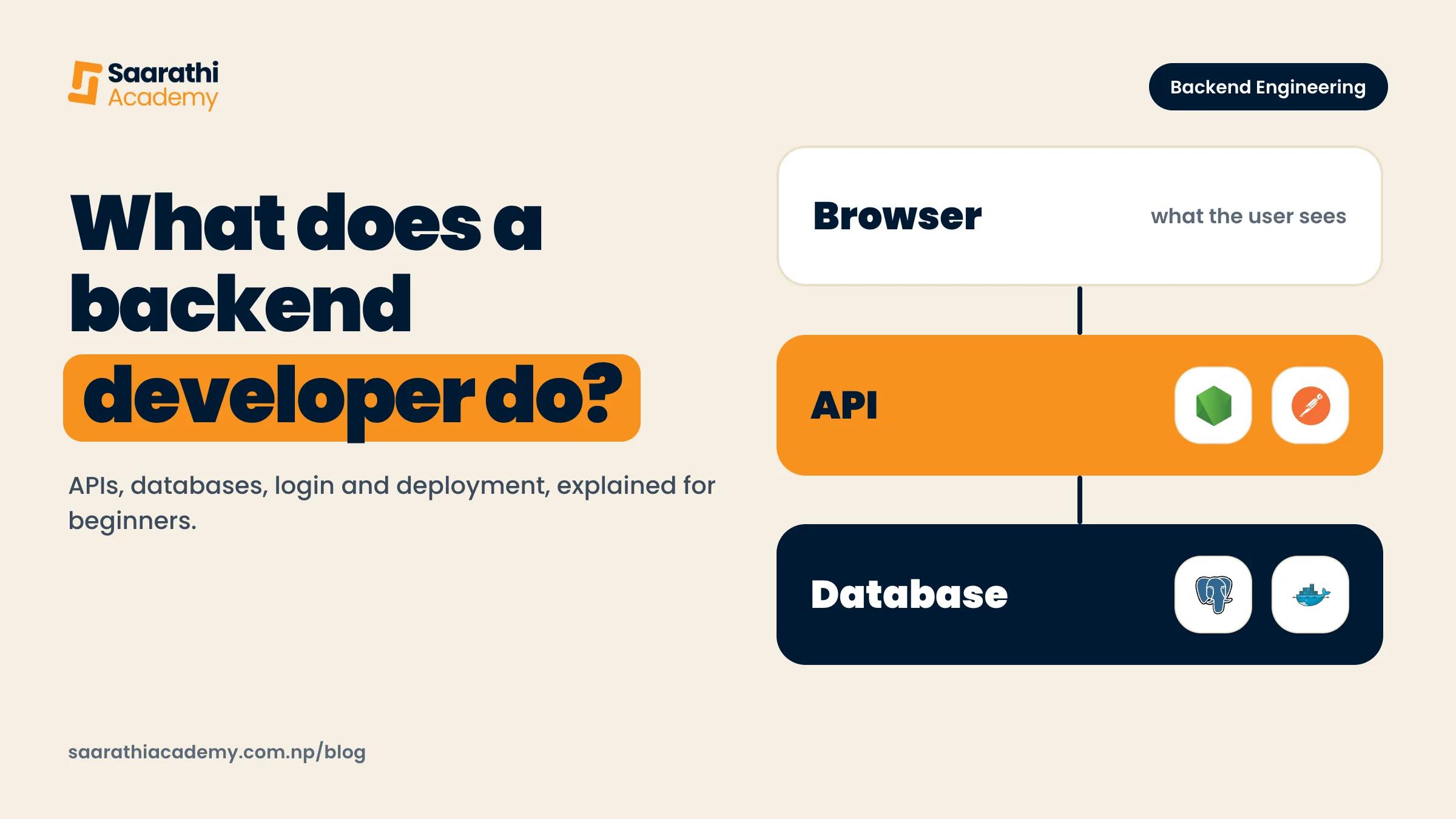
Backend developers build the part of an app you never see. You log in, place an order or send a message, and a server checks who you are, saves the data, talks to other services and sends back an answer. That server code and the database behind it are the backend.
Students in a backend course in Kathmandu usually come from one of these groups:
- Fresh graduates from BIT, BCA, BSc CSIT or engineering. They studied programming in college but have never built a full API that someone else depends on.
- Frontend developers who can build a React page and want to know what happens on the server when that page calls it.
- Career changers with no coding background. It can work, but only if you practise every day for the whole course.
Who should wait? Anyone who can't practise most days for two or three months, and anyone who expects a certificate on its own to open doors. Backend hiring looks at what you built and how you explain it. If a course tells you straight that it doesn't suit you yet, it has done you a favour.
What a complete backend syllabus must cover
Spend most of your decision here. A syllabus that just says "Node.js" or "APIs" tells you very little. A serious one lists the topics week by week and names the tools you will use.
A backend course worth your time should cover these areas:
- How the web works: HTTP, requests and responses, status codes, the Linux terminal and Git. Everything later sits on top of this.
- The language itself. For a Node.js course that means real JavaScript first, then async code, and ideally TypeScript. Skip straight to a framework and the gaps show up in every interview.
- A framework and REST API design, with routes, validation, error handling and clear API documentation.
- Databases: SQL, joins, data modelling, and at least one real database such as PostgreSQL. A few days is not enough for this.
- Authentication and security. Logins, tokens, password storage, roles and permissions, which almost every real backend needs.
- Performance and scale, meaning caching, queues and some system design, so you can talk about what happens when traffic grows.
- Deployment with Docker, a server, HTTPS and a basic CI/CD pipeline, so your work runs somewhere other than your laptop.
Short courses cut two topics more often than any others. One is the database. Some courses spend a long time on a framework and then treat the database as an afterthought, yet in real jobs slow queries and bad data models cause more trouble than whichever framework you picked. The other is deployment. Finish with code that only runs on your own machine and you have nothing live to show anyone.
Check the order of topics as well. The language should come before the framework, and the database should arrive once you already have a working API to connect it to. When a syllabus jumps into a framework on day one with no language foundation, beginners usually end up copying code they can't explain.
Still deciding between stacks? Our guide on MERN stack vs PERN stack web development training in Nepal explains how the main JavaScript stacks differ.
One stack in depth, or many on the surface
Some courses list five or six frameworks and languages. It looks like more for your money, but you rarely get good at any of them. Every stack handles the same flow: a request comes in, gets checked, runs some business logic, touches the database and returns a response. Learn that flow properly in one stack and it carries over to the others. Ask the institute which stack they go deep in, and why.
Know the local market too. Kathmandu hires a lot of PHP and Laravel developers, and Node.js roles are a smaller share of local openings, though Node.js is common with remote and international teams. Either choice is fine as long as you make it knowing that.
Backend course in Kathmandu: duration, format and batch size
Most backend courses here run somewhere between two and four months, and the length alone tells you little. Look at the total number of guided hours, how many days a week you attend and how much practice they expect outside class.
Questions worth asking:
- How many hours of live class are there in total, and on which days?
- How much self-study does the course expect each day?
- Is there a set time for revision or for getting unstuck?
- Is there an online option, and do online students get the same feedback?
Batch size matters more than most people think. Backend code breaks in ways that are hard to fix alone, and the error might be in the code, the database, the environment or a typo in a config file. With 10 people in the room, a mentor can look at your screen and find it with you. With 40, you wait, or you give up and copy someone else's code. Ask for the maximum batch size in writing. An average is no use to you.
If you are working or studying alongside the course, hold the class time up against your week before you join. Most people who fall behind do it by missing two or three sessions in a row.
Prerequisites: what you really need before you join
Lots of students worry they need to know coding already. That depends entirely on the course, so ask. A course that says "no coding needed" should be able to show you where in the syllabus the language is taught from the beginning, and for how long. One or two days of JavaScript won't carry a true beginner.
Whatever the course says, you will need:
- A laptop that can run a code editor, a terminal and Docker.
- Basic comfort with a computer, like installing software and following setup steps.
- Time to practise between classes, usually an hour or two a day.
Watch for any kind of starting check before class begins. It tells the mentor where each student stands, so nobody gets lost in week one.
Projects and your portfolio
For a backend developer the portfolio is the proof. Employers in Nepal open your GitHub, ask you to explain your code and often hand you a take-home task. A certificate can't do any of that for you.
When you ask about projects, push for specific answers:
- Do you build one large project across the course, or only small exercises?
- Do you choose the project, or does everyone build the same copy?
- Does it use a real database, authentication and proper error handling?
- Will it be deployed live with a public URL by the end?
- Does a mentor review the code, or only check that it runs?
A good final project looks like a booking system that stops two people booking the same slot, an e-commerce backend or a chat service. Each of those makes you deal with data consistency and security. A to-do list API built in one evening never gets near those problems.
What the work looks like after a backend course
Entry roles usually have titles like Backend Intern, Junior Backend Developer or Node.js Developer. You'll find them at product companies, software agencies and startups in Kathmandu, and on remote teams working for companies abroad.
Be wary of any course that promises a specific job or a specific outcome. No institute controls who gets hired. What a course can control is what you learn, what you build and how ready you are for interviews.
Backend interviews in Nepal tend to follow a few patterns. Larger product companies may start with an online coding test, then technical and design rounds. Many mid-sized companies set a written test on site first. Startups often begin with an informal chat with a lead and then give a take-home task. The written rounds are usually more basic than people expect, things like string problems and SQL joins, so it helps if your course gets you ready for these formats.
What career support and job help should mean
Almost every course mentions career support or job help, and the words mean very little until you see what is included. Ask for the list. Useful support usually looks like this:
- A mock interview with someone who has done real backend hiring.
- Feedback on your CV, GitHub and LinkedIn profile.
- Practice with the kinds of questions local companies ask.
- Referrals to companies, if the institute actually has contacts.
Then ask whether they promise you a job. The right answer is no. A placement promise usually comes with conditions you only read about later. Good job help gets you ready and opens a few doors, and the employer still makes the hiring decision.
The checklist: how to judge any backend course in Kathmandu
Take this list with you when you visit or call an institute, and write down each answer.
- Can I see the full syllabus, week by week?
- Does it cover the language, a framework, SQL databases, authentication, caching or queues, system design and deployment?
- What is the maximum number of students in one batch?
- Who teaches, and do they currently work on backend systems?
- How many guided hours are there, and how much self-study is expected?
- Is there an online option with the same feedback as the classroom?
- Do I need coding experience, and where is the language taught?
- What project will I finish, and will it be deployed live?
- How am I assessed at the end?
- What exactly does the career support include, and do you promise placement?
For judging training centres in general, not only backend ones, see our guide on how to choose an IT training center in Nepal.
Teaching quality: learning with mentors
The syllabus tells you what gets taught, and the mentor decides how well. Backend is full of small details, like how a transaction behaves when two requests arrive at once, or why an index makes one query fast and another slow. Someone who works on real backends knows which of those details come up at work and in interviews.
Ask to meet the mentor, or at least ask what they work on now and how they give feedback on code. A mentor reviewing your pull requests is a very different thing from watching recorded videos and checking your own answers.
Ask what happens when you fall behind, too. Is there revision time? Can you get help outside class hours? A course built for beginners should have a plan for the week when something doesn't click.
Building skills after the course ends
No course covers everything, and backend tools keep changing. Once yours ends, keep going:
- Keep working on your capstone. Add tests, logging or a new feature, and write up what you changed.
- Read the official documentation for your framework and database. It is often clearer than tutorials.
- Build one more small project on your own, with no guide, to prove to yourself you can.
- Learn more about deployment and cloud basics; our post on cloud DevOps training in Nepal covers that side.
- Apply for internships and junior roles while you keep building. The interviews will show you what to study next.
How Saarathi Academy measures against the checklist
Here is how our own Backend Engineering course in Kathmandu answers each point, going by what the course page states.
- The syllabus runs 10 weeks and is listed week by week. It opens with how the web works, the Linux terminal and Git, then moves through JavaScript, async JavaScript and TypeScript, Express and REST API design, NestJS, SQL and PostgreSQL with Prisma, database internals and caching, and auth and security with queues and real-time features. There is a full week of system design, and the final week covers DevOps and getting hired.
- A batch has at most 10 students in the room, plus up to 5 online seats.
- The mentors still do the job they teach.
- Classes run Monday to Friday, 2 hours a day, about 100 hours in total. Plan on about two more hours of self-study a day. On Day 5 of every week the last hour of the live session is revision and architecture review, and Sunday is an open classroom for enrolled students.
- You can join online or offline and get the same mentor feedback either way. The classroom is in Old Baneshwor, Kathmandu.
- No prior coding is required. JavaScript and TypeScript are taught from scratch across Weeks 2 and 3, and a diagnostic assessment before Day 1 maps your starting point.
- In Week 5 you pick one capstone with your mentor. You build it across Weeks 5 to 10, write a design doc, and deploy it live with Docker, CI/CD and a public HTTPS URL.
- You are assessed with a proctored certification exam plus a capstone project review.
- Career support covers a 1:1 mock interview, CV and LinkedIn audits, help with your GitHub, and referrals into our hiring network. We do not guarantee placements.
The full week-by-week plan and the syllabus PDF are on the backend engineering course page. Whichever course you choose, take the same checklist with you. The right one answers every question clearly.